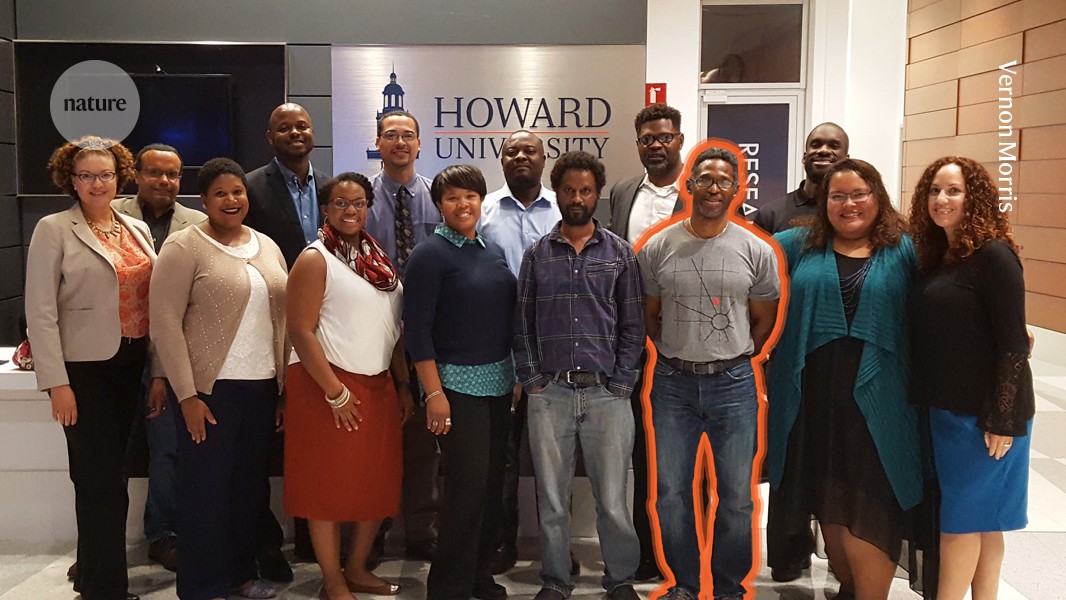
"When Vernon Morris earned his doctorate in Earth and atmospheric sciences in 1991 from the Georgia Institute of Technology in Atlanta, he was the first African American to do so, joining fewer than a dozen other Black atmospheric sciences PhD holders in the United States at that time. From the get-go, Morris knew that something needed to change to create more opportunities for Black scientists in his field. In 2001, as a professor at Howard University in Washington DC, he became founding director of the first PhD-granting graduate programme in atmospheric sciences at a historically Black college and university (HBCU)."
"For example, Morris studies microbial populations found on grains of desert sand transported from Africa to the Caribbean, and then on to the continental United States and South America. "We're finding fairly rich microbial populations on those" grains, he says, and the populations "change as the surface chemistry changes". These microorganisms can affect ecosystem health in the oceans or in soils where they are deposited, he notes. Understanding particle transport "can have domino effects in how we understand biogeochemistry and microbial exchange between continents", he says."
Vernon Morris became one of the earliest Black atmospheric-science PhD holders and established the first PhD-granting atmospheric-science programme at an HBCU. The Howard University programme produced a significant portion of African American and Latinx PhD graduates in atmospheric sciences between 2006 and 2018. Morris specializes in airborne particle processes and investigates long-range transport of mineral dust from deserts and populated regions. His team's work informs global and regional weather and climate models used in hurricane and tropical-storm forecasting. He examines microbial communities on transported dust grains and their potential impacts on ocean and soil ecosystems and intercontinental biogeochemical exchange.
#diversity-in-stem #hbcu-graduate-programs #atmospheric-sciences #aerosol-transport #microbial-biogeochemistry
Read at Nature
Unable to calculate read time
Collection
[
|
...
]