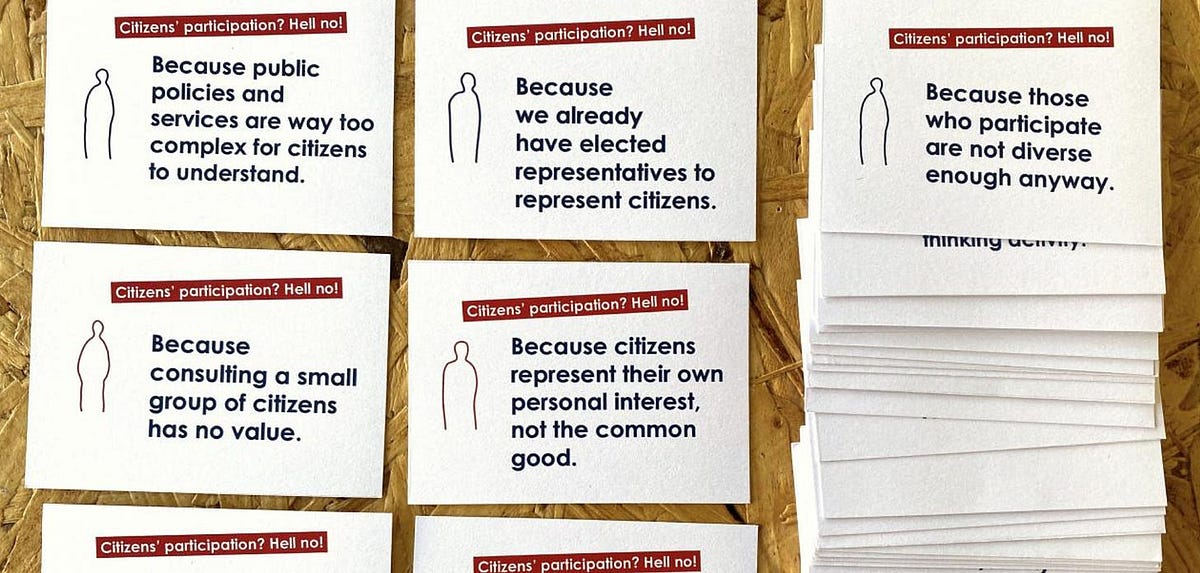
"Over the past eight years, I've been fortunate to work with a broad range of people - from children on dialysis wards or someone's friend's uncle in Germany looking to rent power tools to everyday citizens wanting to inquire about their tax bill, and the people I work with. Across all of these experiences, I've come to trust something quite simple."
"Given that I'm currently working with a brilliant teaching team on the MPA in Innovation, Public Policy and Public Value at UCL's Institute for Innovation and Public Purpose - with Rowan Conway, Gabriella Gomez-Mont, Agostina Argiro Fuertes, Cecilia Santucho and Nickolas Laport Aldunate - supporting students to start tuning into how we better engage, enable and empower citizens through participatory scaffolding, it felt timely to pause and reflect on what it really means to include citizens in the design process."
Meaningful citizen participation redistributes agency, enabling people to shape decisions, define problems, and co-create public services and outcomes. Practice across diverse settings — hospitals, streets, schools, workshops, and households — shows that trust and respect are built by being on site and doing things together rather than relying on office or spreadsheet work. Engaging citizens in defining needs, shaping responses, and proposing designs improves solutions and produces collective action. Teaching and facilitation can tune students and practitioners to engage, enable, and empower citizens through participatory scaffolding. Fieldwork, facilitation, practice, and research inform practical notes and lessons for inclusive public design.
Read at Medium
Unable to calculate read time
Collection
[
|
...
]