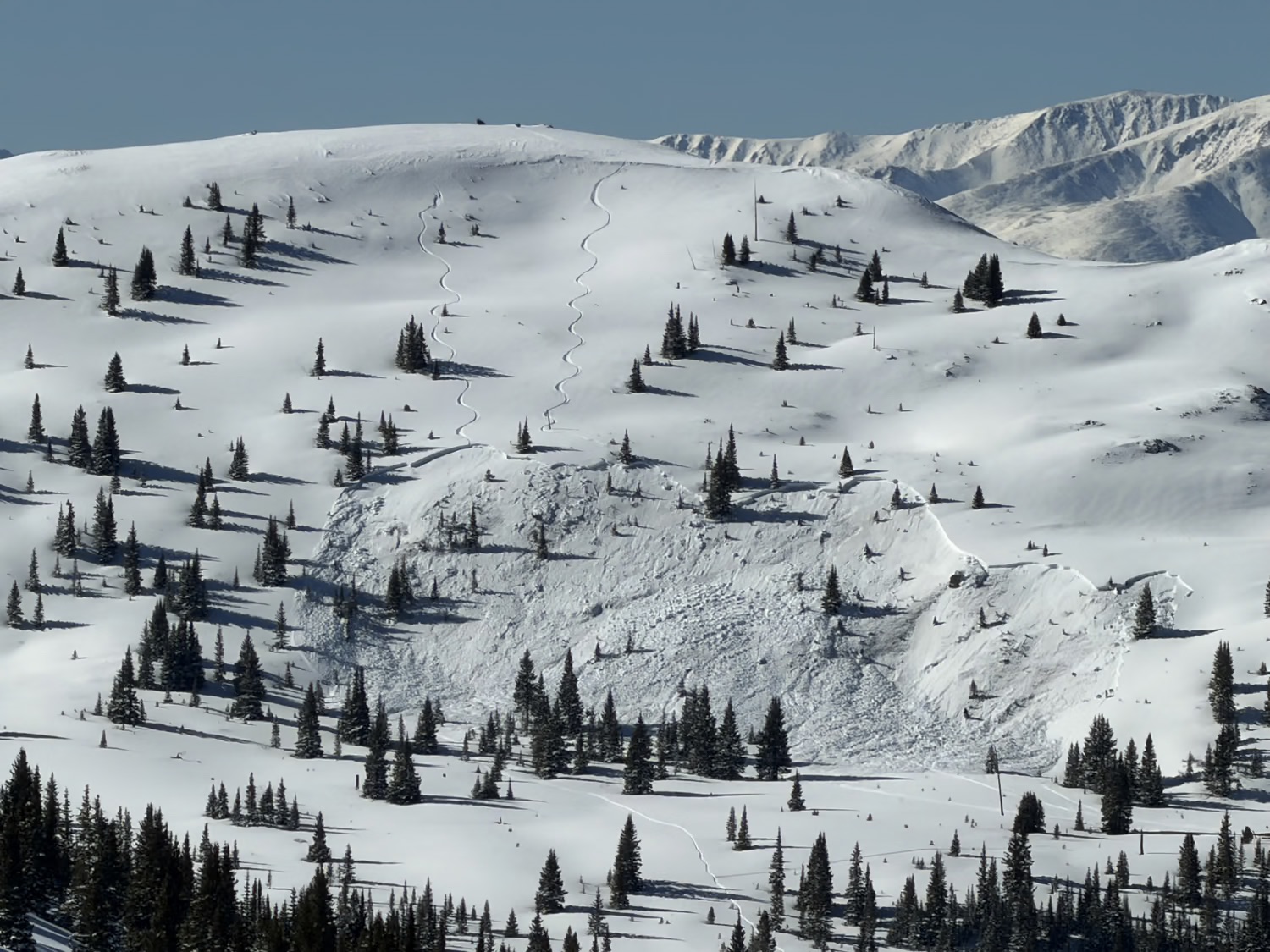
A fatal avalanche occurred in Boss Basin near Vail Pass, Colorado, when a solo backcountry skier triggered a hard-slab slide on a northeast-facing slope during his second descent. The avalanche released on a weak layer of faceted crystals and stepped down to ground, spanning 400 feet wide with a crown face 1 to 3 feet deep. The slope angle of 33 to 36 degrees transitioned to a flat bench, creating a terrain trap where debris accumulated 4 to 9 feet deep. Historically low snowfall that winter, combined with prolonged dry periods in January that formed weak faceted layers, followed by February and early March storms that buried these layers, created unstable snowpack conditions. Nine inches of new snow fell on the day of the accident.
"The avalanche released on a weak layer of buried faceted crystals and stepped down to the ground, taking the entire season's snowpack with it. It was classified as medium-sized relative to the path and large enough to injure, bury, or kill a person. The crown face ranged from 1 to 3 feet deep and was about 400 feet wide."
"The winter prior to March 2026 had historically low snowfall. A Copper Mountain SNOTEL station 5 miles from the site reported only 7.8 inches of snow water equivalent on March 7, which was 65% of the 30-year median. The shallow snowpack and prolonged dry periods allowed weak layers of faceted grains to form through January."
"The slope angle below the crown ranged from 33 to 36 degrees before ending in a flat bench. This transition formed a terrain trap, allowing the avalanche debris to pile 4 to 9 feet deep, despite the avalanche only running about 180 vertical feet through sparse trees."
Read at SnowBrains
Unable to calculate read time
Collection
[
|
...
]