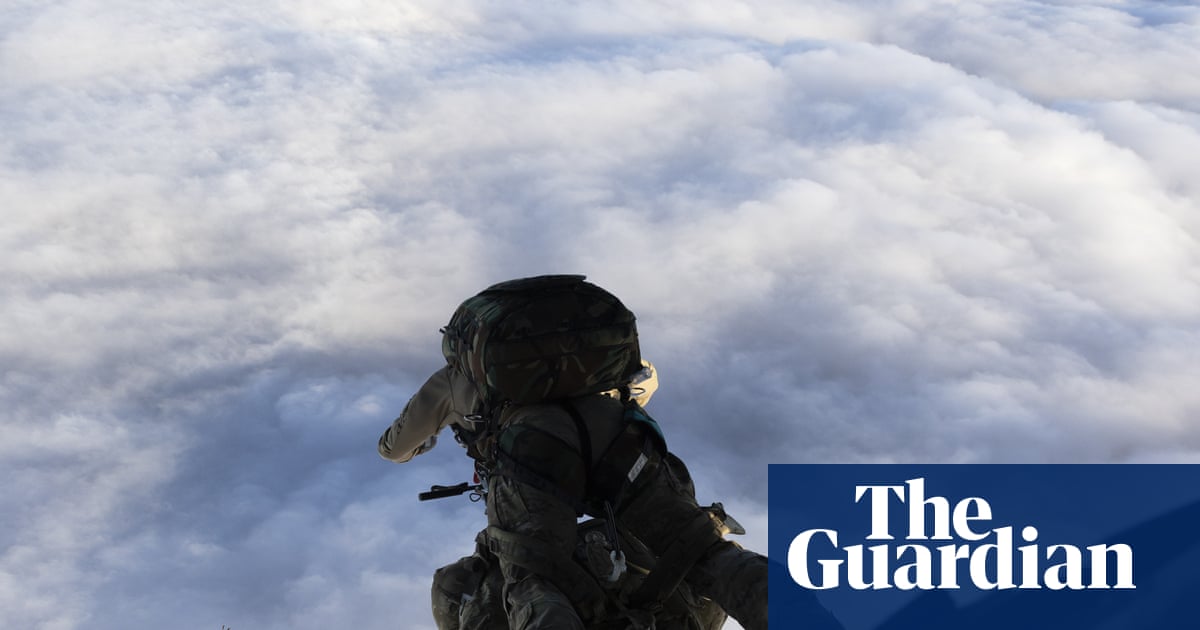
"The hardest part of the parachute jump, according to Capt George Lacey, is falling backwards through the air. It is Saturday and Lacey, and his squad of six plus two medics, have just leapt out of an RAF transport, 2,500 metres over the south Atlantic. The parachute can only go forward so quickly, he says, meaning that it has to be pulled at precisely the right moment. So you have to turn into the wind and basically fly backwards, which is a very weird sensation, as you can imagine."
"Below, with only its volcanic peak visible above the prevailing cloud cover, was Tristan da Cunha, the most remote of the British overseas territories, population 221, normally accessible only by boat, six days' sail from Cape Town or the Falklands. A resident suspected of having coming down with hantavirus after disembarking from the ill-fated MV Hondius cruise ship last month needed urgent treatment, including oxygen. It had been deemed there was only one way to get supplies over quickly enough."
"Lacey and the other five, Pathfinders from the British army's 16 Air Assault Brigade, learned they would be needed in the afternoon of Thursday last week, flying first to Brize Norton, then to Ascension Island, 2,000 miles to the north of Tristan da Cunha, to get ready for the drop. The six are experienced parachutists Lacey says he has done nearly 200 jumps but with them were a doctor and an intensive care nurse, who would be strapped to two of the jumpers, an extra but necessary complication."
"Together they took a four-and-a-half-hour flight from Ascension in an A400M transport, and when the plane refuelled midway, Lacey knew for sure the weather was good enough and. Before the jump, you're just thinking of exactly what you need to do next, because there's almost an overload of information and sensation'."
A parachute drop over the south Atlantic required precise timing because the parachute can only deploy forward at a limited rate. Jumpers had to turn into the wind and effectively fly backward to ensure the parachute opened correctly. Six experienced Pathfinders from the British Army’s 16 Air Assault Brigade, along with two medics, were deployed after being notified for an afternoon drop. The team traveled from Brize Norton to Ascension Island and then flew to the drop point in an A400M transport. A suspected hantavirus case on Tristan da Cunha required urgent oxygen and treatment, and supplies were delivered by parachute because boat access takes about six days. The medics were strapped to jumpers, adding complexity to the operation.
Read at www.theguardian.com
Unable to calculate read time
Collection
[
|
...
]