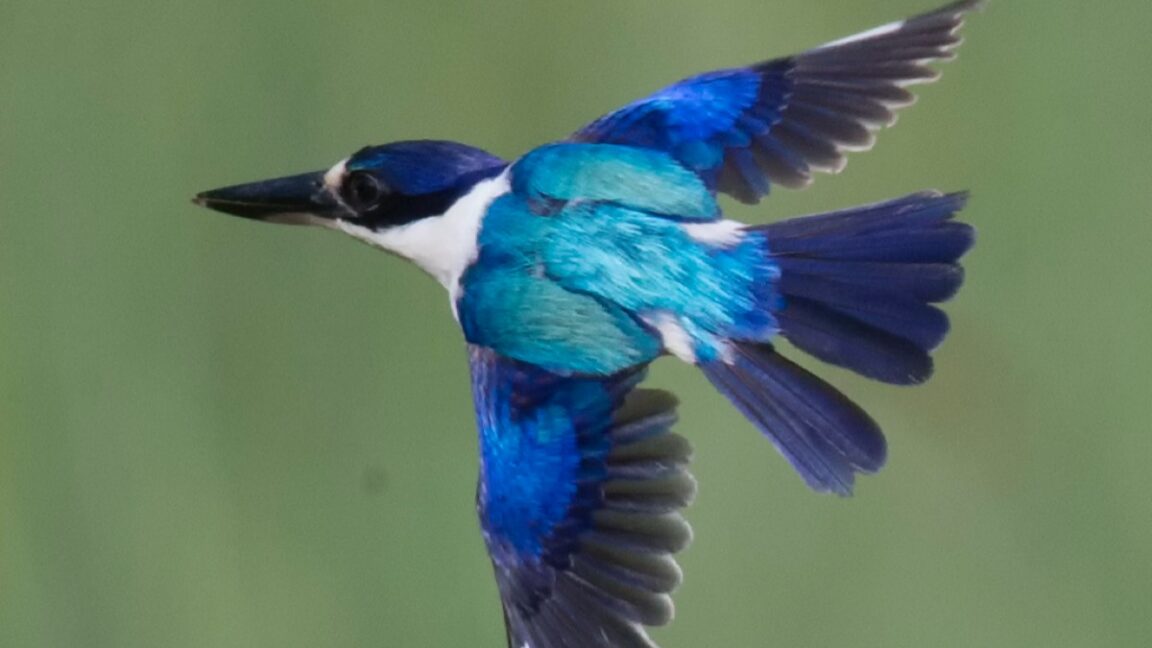
"The Northwestern team started looking at kingfisher feathers in tian-tsui objects via postdoc Madeline Meier, who has a background in chemistry and nanostructures, and was interested in combining that expertise with studies of cultural heritage. The first step was to identify the bird species that provided the feathers used in Qing dynasty screens and panels, as well as other materials used."
"The team also made use of the center's partnership with Chicago's Field Museum, comparing the screen feathers with the museum's vast collection of taxidermied bird species. The screens and panels contained feathers from common kingfishers and black-capped kingfishers, as well as mallard ducks (used to add green hues). Finally, x-ray fluorescence and Fourier-transform infrared spectroscopy enabled them to create a map of the various chemicals used in the gilding, pigments, glues, and other materials."
Researchers identified bird species used in Qing dynasty tian-tsui screens by scraping surface layers and imaging feathers with scanning electron microscopy to reveal underlying nanostructures. Hyperspectral imaging showed how different screen areas absorbed and reflected light. Comparisons with taxidermied specimens at the Field Museum confirmed use of common kingfishers, black-capped kingfishers, and mallard ducks for green hues. X-ray fluorescence and Fourier-transform infrared spectroscopy mapped chemicals in gilding, pigments, glues, and other materials. A partnership with Argonne National Laboratory applied synchrotron radiation for noninvasive, higher-resolution imaging, leveraging intense, focused X-ray beams produced by accelerated electrons in a storage ring.
Read at Ars Technica
Unable to calculate read time
Collection
[
|
...
]