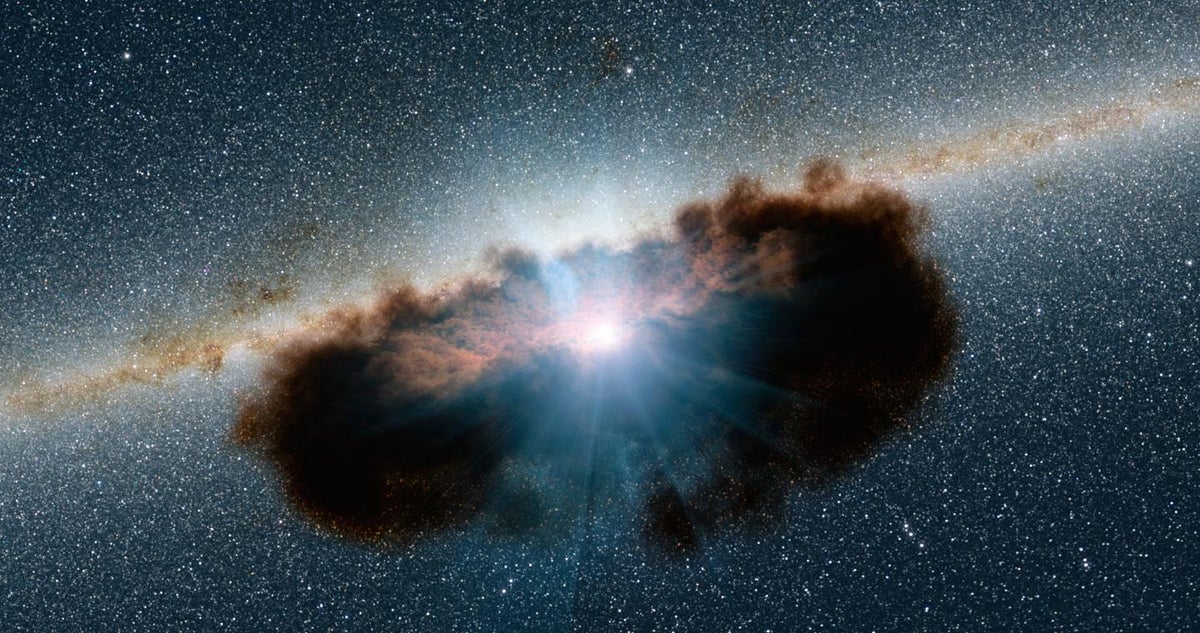
Little red dots (LRDs) are ruby-red, compact luminous objects seen by JWST that can appear star-like yet span up to 500 light-years. LRDs account for roughly ten percent of luminous sources in deep JWST surveys probing epochs when the universe was about five to fifteen percent of its current age. A leading hypothesis proposes that LRDs are a new class of galaxy powered by rapid accretion onto growing black holes, with infalling plasma heating a dense cocoon of gas that radiates red. Modern black holes lack such cocoons, so how these envelopes were lost remains an open question. A recently identified object combines LRD redness with X-ray emission, strengthening the connection to accreting black holes and intensifying the debate about cocoon evolution.
"First glimpsed in some of JWST's earliest images, LRDs remain one of the telescope's biggest surprisesruby-red objects that shine like a star but may reach up to 500 light-years in size. Whatever they are, LRDs certainly aren't rare: they seem to constitute nearly 10 percent of the luminous objects JWST sees in its surveys of faraway cosmic realmsinvestigations in which the telescope has looked back to a time when the universe was between about 5 and 15 percent of its 13.8-billion-year age."
"According to this idea, although these objects may look like supersize red stars, their shine is powered not by standard stellar thermonuclear fusion but rather by the relentless funneling of burning-hot plasma into the insatiable maw of a snowballing black hole. That fiery process heats a thick cocoon of gas surrounding and feeding the black hole, which then glows like a ruddy heat lamp."
"The idea remains divisive, and it leaves one big question unanswered. None of the black holes we see in today's universe are ensconced in such dense gaseous envelopes. So if LRDs are really black hole stars, then how did they shed their cocoon? Now a group of researchers have uncovered an unusual object that has added more fuel to that debate. It combines the redness of an LRD with the telltale x-ray emission"
Read at www.scientificamerican.com
Unable to calculate read time
Collection
[
|
...
]