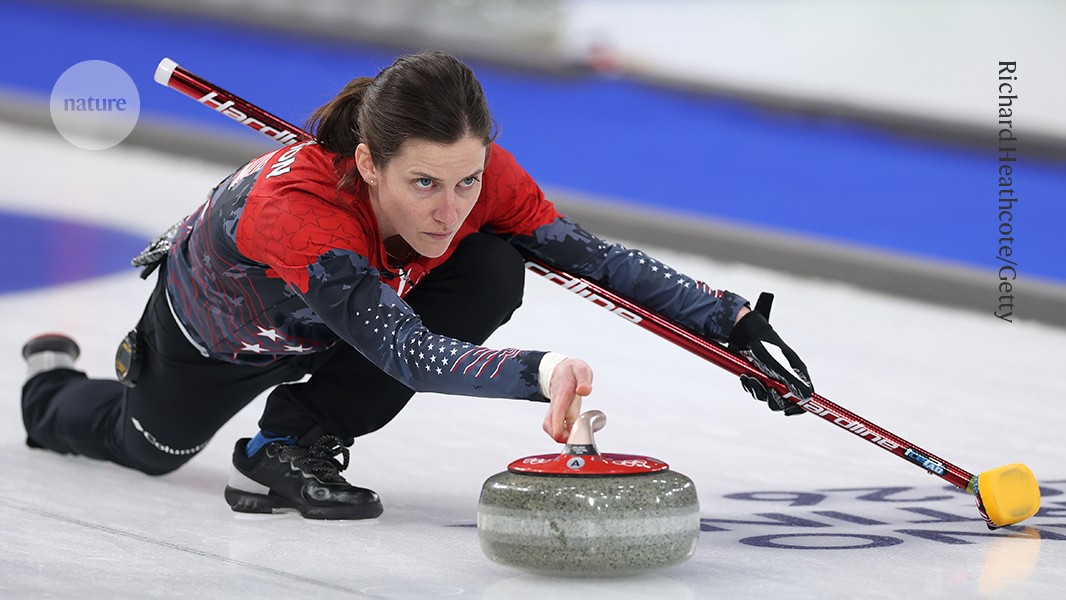
"Athletes seem to be testing the laws of nature every day in the 2026 Olympic Winter Games in Italy, with figure skaters spinning four full times in a single jump and bobsledders withstanding forces five times stronger than gravity. But one sport in particular is fascinating scientists. After more than a century of research, physicists still don't entirely understand curling. Specifically, why the heavy granite curling stones move in the opposite way to what is expected as they travel across the ice."
"The sport of curling, which made an appearance at the inaugural 1924 Winter Olympics, involves two teams of four taking turns to slide granite stones weighing about 19 kilograms across a sheet of ice towards a target. Each team member gives two of the roughened stones a push across the ice - which is scattered, or 'pebbled', with frozen water droplets - while applying some spin."
"Although the ultimate goal of the game is simple - to be the team with a stone (or stones) closest to the target - curling's inner physics is perplexing. If you spin a round object such as a bowl clockwise on the floor while pushing it forwards, you'll find, time and time again, that it curls to the left - the opposite of what you see in the Olympics livestream."
Curling involves two teams sliding about 19-kilogram granite stones across pebbled ice toward a target, with each thrower imparting spin that makes the stone curl and teammates sweeping the ice to influence distance. A clockwise spin produces rightward curl and vice versa, and friction against the pebbled surface eventually stops the stone. The observed curling direction contradicts intuitive behavior of other spinning round objects, which curl oppositely when rolled while spinning. Physicists have investigated the phenomenon for more than a century and remain divided into competing camps supporting different hypotheses about the running band and ice interactions.
Read at Nature
Unable to calculate read time
Collection
[
|
...
]