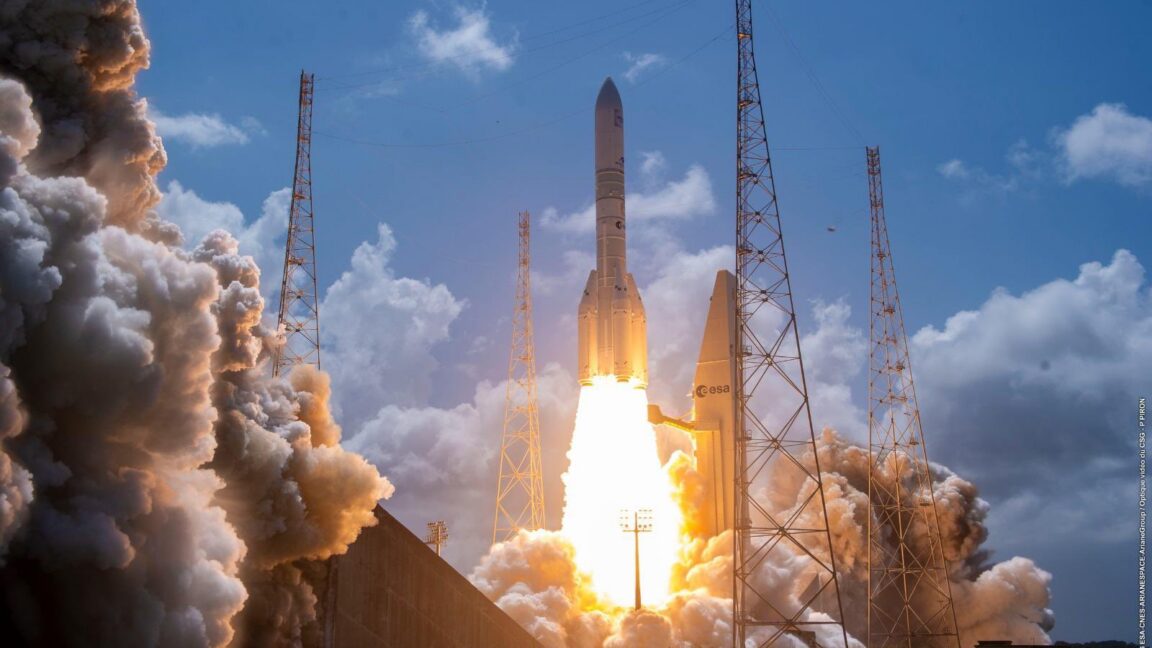
"The Ariane 64 flew with an extended payload shroud to fit all 32 Amazon Leo satellites. Combined, the payload totaled around 20 metric tons, or about 44,000 pounds, according to Arianespace. This is close to maxing out the Ariane 64's lift capability. Amazon has booked more than 100 missions across four launch providers to populate the company's planned fleet of more than 3,200 satellites. With Thursday's launch, Amazon has launched 214 production satellites on eight missions with United Launch Alliance, SpaceX, and now Arianespace."
"The Amazon Leo constellation is a competitor with SpaceX's Starlink Internet network. SpaceX now has more than 9,000 satellites in orbit beaming broadband to more than 9 million subscribers, and all have launched on the company's own Falcon 9 rockets. Amazon, meanwhile, initially bypassed SpaceX when selecting which companies would launch satellites for the Amazon Leo program, formerly known as Project Kuiper."
"Amazon booked the last nine launches on ULA's soon-to-retire Atlas V, five of which have now flown, and reserved the rest of its launches in 2022 on rockets that had never launched before: 38 flights on ULA's new Vulcan rocket, 24 launches on Blue Origin's New Glenn, and 18 on Europe's Ariane 6. All three new rockets suffered delays but are now in service. The Ariane 6 has enjoyed the fastest ramp-up in launch cadence, with six flights under its belt after Thursday's mission."
An Ariane 64 used an extended payload shroud to carry 32 Amazon Leo satellites, about 20 metric tons, nearing the rocket's lift limit. Amazon has scheduled over 100 launches with four providers to build a planned fleet exceeding 3,200 satellites; 214 production satellites have now flown on eight missions with ULA, SpaceX, and Arianespace. Amazon Leo competes directly with SpaceX's Starlink, while SpaceX already operates over 9,000 broadband satellites serving more than 9 million subscribers. Amazon reserved flights on ULA's Vulcan, Blue Origin's New Glenn, and Europe's Ariane 6, though recent Vulcan booster anomalies raise timing concerns.
Read at Ars Technica
Unable to calculate read time
Collection
[
|
...
]