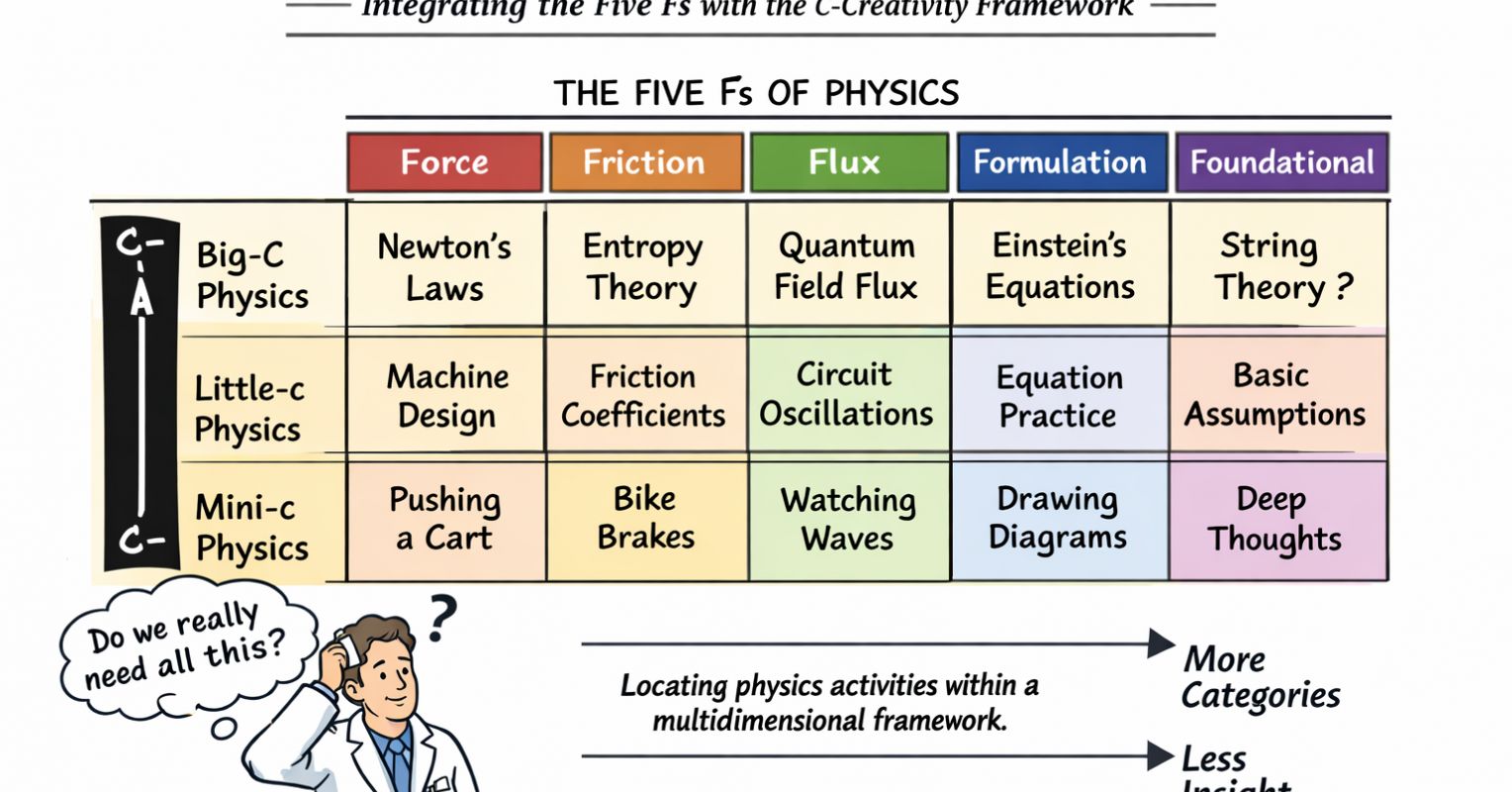
"Recent integrative approaches suggest that physics cannot be adequately characterized by magnitude-based distinctions alone, such as those implied by Big-P, little-p, and mini-p physics. While these categories capture differences in scope and historical impact, they fail to address the heterogeneity of physical activity itself. To remedy this, I propose the Five Fs of physics: force, friction, flux, formulation, and foundational structure."
"Force physics concerns direct causal interactions involving pushes, pulls, and accelerations. These interactions are present across mini-p, little-p, and Big-P physics alike, from everyday embodied encounters to formal theoretical treatments. Force physics thus cuts across P-levels without being reducible to any one of them. Friction physics captures resistive, dissipative, and constraining aspects of physical systems, including drag, loss, and entropy-increasing processes. Frictional considerations often dominate little-p applied physics, yet they also appear in Big-P contexts, such as theoretical treatments of irreversibility."
Some commonly used psychological methods are theoretically impoverished, a limitation that becomes apparent when those methods are applied to physics. Magnitude-based distinctions such as Big-P, little-p, and mini-p capture differences in scope and historical impact but fail to address the heterogeneity of physical activity. Five Fs of physics are force, friction, flux, formulation, and foundational structure. Force concerns direct causal interactions like pushes, pulls, and accelerations across P-levels. Friction covers resistive, dissipative, and entropy-related constraints. Flux denotes continuous change and energy transfer. Formulation involves representational encoding through equations, diagrams, and simulations, and foundational structure addresses underlying theoretical architecture.
Read at Psychology Today
Unable to calculate read time
Collection
[
|
...
]