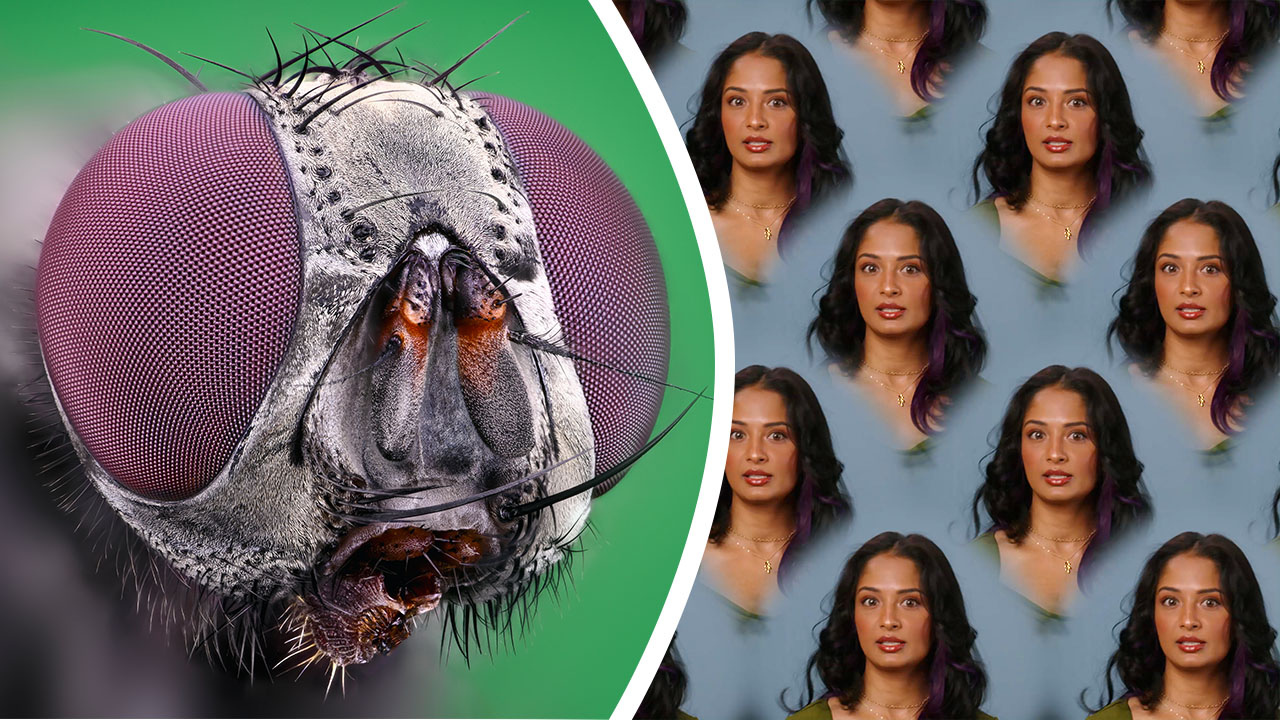
"On a spring day in 1694, Antonie van Leeuwenhoek - the father of microbiology - used a magnifying lens to look at a candle through the dissected eye of a dragonfly. But instead of seeing 1 candle flame, he saw hundreds of tiny flames, repeated over and over. But spoiler alert - this is not how insects see. Hi, I'm Niba, and today we're going to explore how insects really see the world."
"Okay, let's get up close and personal with the compound eye. All adult insects with vision have them. And since insects make up oh, somewhere around 75 to 80 percent of all known animal species on Earth, the compound eye has the distinction of being the most common type of eye in the entire animal kingdom. But it's not just insects. Other species have compound eyes, too."
"Some crustaceans, like the mantis shrimp, have them. And so do some segmented worms, like the fan worm, that have their compound eyes positioned on a pair of specialized tentacles. Tentacles that can see. Now take an even closer look at the insect compound eye. There's a collection of hundreds - sometimes thousands - of individual eye units. One unit is called an ommatidiu"
Compound eyes are composed of hundreds to thousands of repeated units called ommatidia. These eyes are the most common eye type on Earth because insects represent roughly 75–80 percent of known animal species. Compound eyes also occur in other groups, such as mantis shrimp and some segmented worms that bear eye-bearing tentacles. Early observations misinterpreted compound eyes as producing many repeated images, but insect vision samples light across units and relies on neural processing to detect motion and perceive color differently from a single-lens eye.
Read at Kqed
Unable to calculate read time
Collection
[
|
...
]