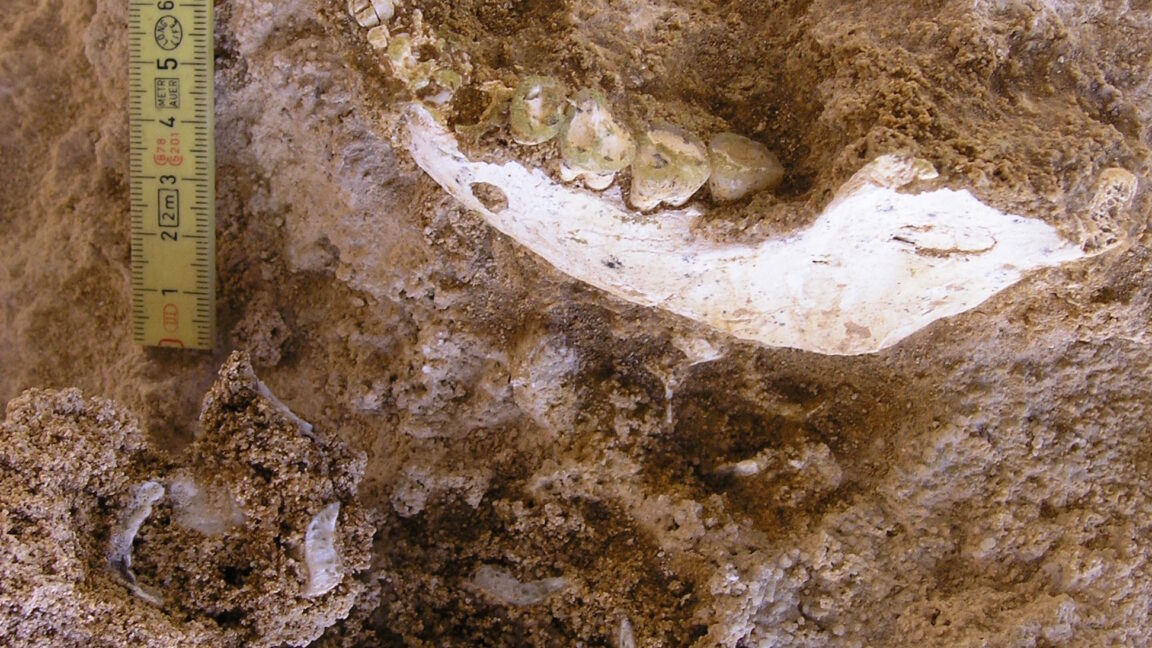
"The Casablanca fossils are about the same age as hominin fossils from Spain, which belong to a species called Homo antecessor. This species has been suggested to be a likely ancestor of Neanderthals and Denisovans. Overall, it looks like the fossils from Casablanca are a North African counterpart to Homo antecessor, with the Spanish hominins eventually leading to Neanderthals and the North African ones eventually leading to us."
"Both groups share some features in their teeth and lower jaws, but they're also different in some important ways. The teeth and chins in particular share some older features with Homo erectus. But the jaws have more newfangled features in the places where chewing muscles once attached to the bone-features that Neanderthals and our species share. On the other hand, the teeth are missing some other relatively recent features that would later help define Neanderthals (and werealready beginning to show up in Homo antecessor)."
"Altogether, it looks like the Homo erectus populations and the Neanderthals and Denisovans had been separated for a while by the time the hominins at Grotte à Hominidés lived. But not that long. These hominins were probably part of a generation that was fairly close to that big split, near the base of our branch of the hominin family tree."
"Based on ancient DNA, it looks like Neanderthals and Denisovans started evolving into two separate species sometime between 470,000 and 430,000 years ago. Meanwhile, our branch would eventually become recognizable as us sometime around 300,000 years ago, or possibly earlier. At various times and places, all three species would eventually come back together to mingle and swap DNA, leaving traces of those interactions buried deep in each other's genomes."
The Casablanca fossils are about the same age as Homo antecessor fossils from Spain. The Casablanca material appears to be a North African counterpart to Homo antecessor, with the Spanish population leading toward Neanderthals and the North African population leading toward modern humans. Both groups share dental and mandibular features, including teeth and chins with older Homo erectus-like traits. The jaws show derived attachment-area morphology shared with Neanderthals and modern humans, while the teeth lack some Neanderthal-defining characters present in Homo antecessor. Genetic evidence places the Neanderthal–Denisovan split between 470,000 and 430,000 years ago, and the modern human lineage becomes recognizable around 300,000 years ago. Interbreeding episodes occurred among the three lineages.
#homo-antecessor #casablanca-fossils #neanderthaldenisovan-divergence #dental-and-mandibular-morphology
Read at Ars Technica
Unable to calculate read time
Collection
[
|
...
]