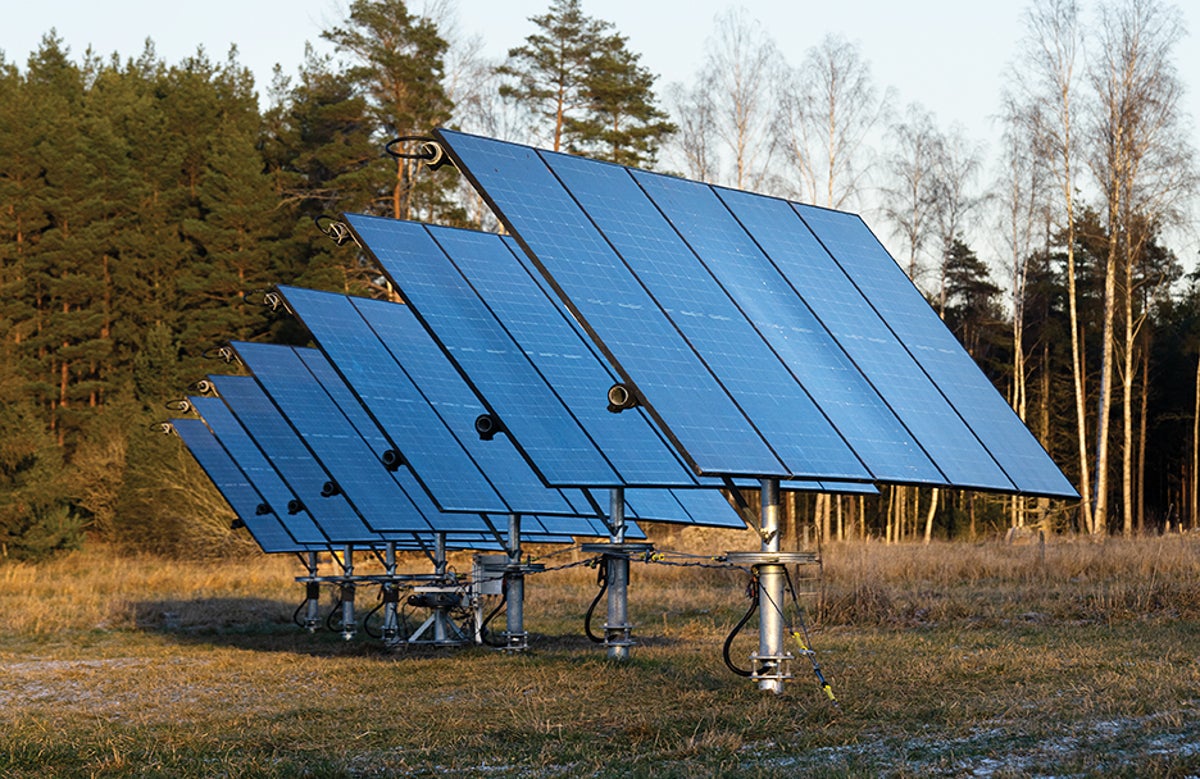
"When the 47th solar panel exploded, Henrik Eskilsson began to fear he'd signed on with a madman. In his SUV, he and Anders Olsson were accelerating across Sweden's Lunda Airfield, towing a trailer fitted with a steel mast that suspended the panel. As they gained speed, the panel did something unusual: It floated, catching the wind like a hang glider while staying anchored to the mast."
"Many areas in the Northern Hemisphere and some in the Southern lie in zones where traditional solar fields are inefficient, especially in winterbut also in the morning and evening. When the sun sits low, its rays hit horizontal panels at a shallow, grazing angle, delivering little energy. Vertical solar panels that track the sun even as it barely clears the tree line have proved too expensive, requiring multiple motors to rotate them, too much concrete to anchor them,"
Henrik Eskilsson and Anders Olsson tested a prototype vertical-tracking solar panel on Sweden's Lunda Airfield that detached and shattered during a high-speed trial. The founders aim to improve solar output in higher-latitude regions where low sun angles reduce efficiency, especially in winter and near sunrise or sunset. Conventional vertical trackers are expensive due to multiple motors, heavy concrete anchors, and steel bracing. Olsson proposed a wind-adaptive design that moves like leaves to remain aligned with the sun; engineers called it impossible, but the founders pursued the concept through their startup Vaja despite repeated prototype failures.
Read at www.scientificamerican.com
Unable to calculate read time
Collection
[
|
...
]