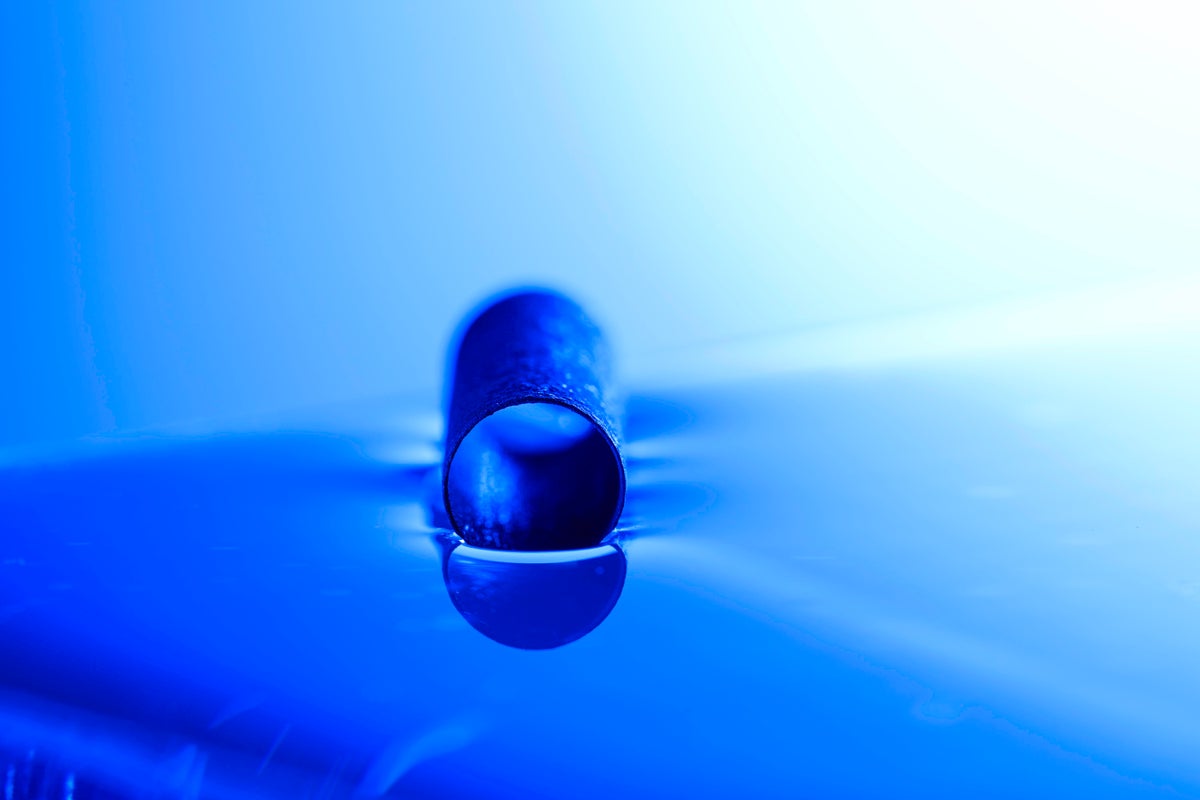
Aluminum tubes can be made superhydrophobic by laser-etching microscopic ridges that trap air within the metal structure. The trapped air prevents water from entering the tubes because surface tension causes water to bounce off the textured surfaces, maintaining buoyancy. The method imitates diving bell spiders, whose fine body hairs capture and hold air bubbles so the spiders can breathe underwater. Even when the tubes are severely damaged or punched with many holes, the superhydrophobic texture preserves the air layer and allows the tubes to float. Superhydrophobicity thus enables metals denser than water to remain buoyant.
"A team at the University of Rochester has etched aluminum tubes so that they won't sink, even when damageda trick the scientists borrowed from spiders. You can poke big holes in them, said Chunlei Guo, a professor of optics and physics at the University of Rochester and senior author of the research, in a press release. We showed that even if you severely damage the tubes with as many holes as you can punch, they still float."
"Many things in our lives repel waterexamples include cooking oil, a rain jacket or a rubber glove. Scientists call this property hydrophobicityfrom the Greek for water fearbut the secret to the metal tubes' buoyancy lies in superhydrophobicity. Guo's team uses lasers to carve microscopic valleys into the aluminum that capture air: picture corduroy fabric shrunk down until it requires an electron microscope to see the ridges."
"According to the press release, the mechanism is similar to how diving bell spiders trap an air bubble to stay buoyant underwater. The spiders live almost entirely underwater but still need to breathe. Their solution is to carry their own oxygen supply. Fine hairs covering their bodies trap air bubbles against their skin. The metal tubes mimic those fine hairs, trapping their own air bubbles."
Read at www.scientificamerican.com
Unable to calculate read time
Collection
[
|
...
]