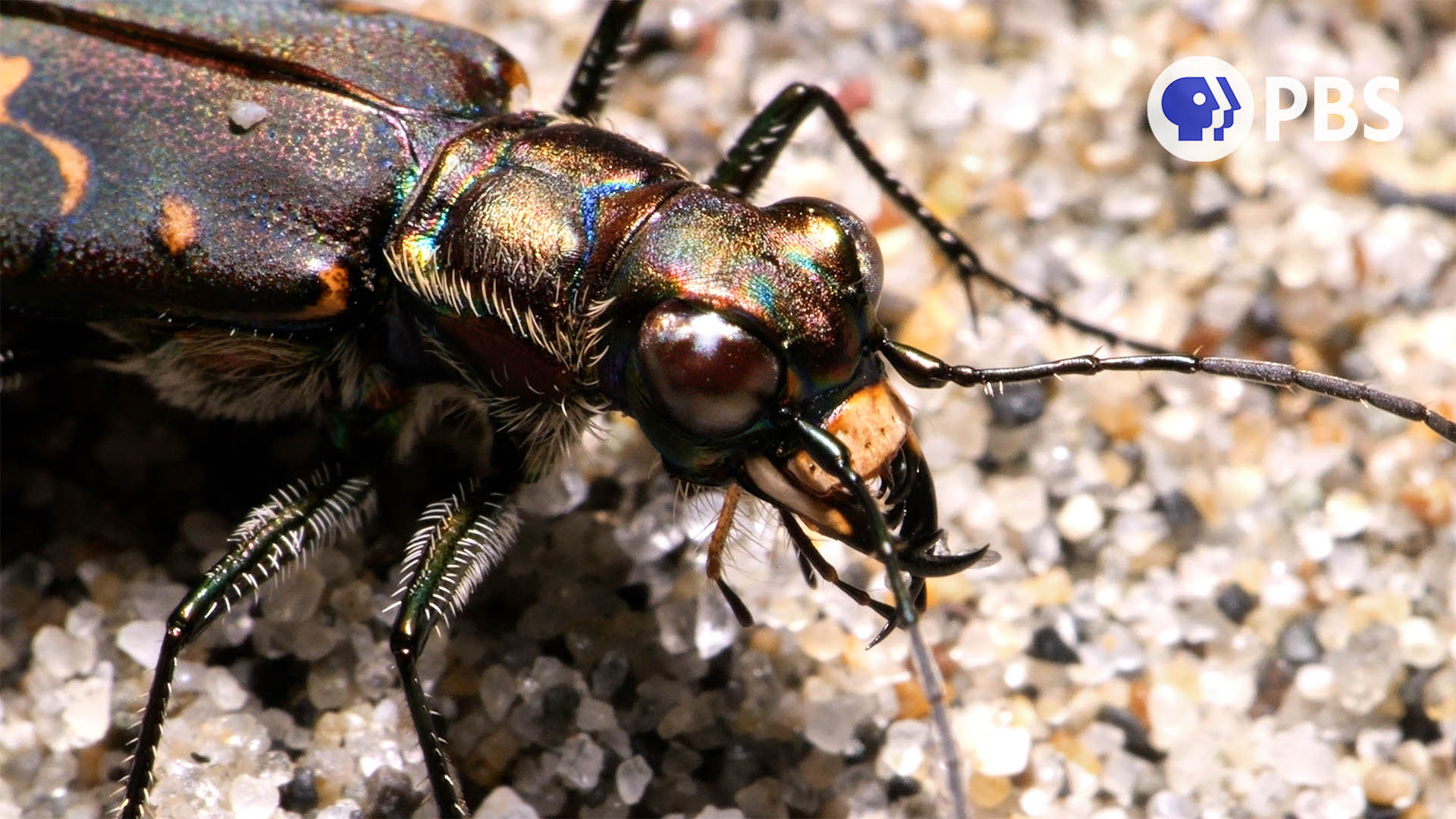
"At those speeds, everything around you becomes a blur. So how do tiger beetles see when they're in a sprint? Well, look how they keep stopping in their tracks. Uhp! Oop! Wup! Hoop! Woo! Researchers at Cornell University filmed a tiger beetle chasing a lure and slowed the footage way down. The researchers think tiger beetles use those quick stops to reorient themselves and find their target again."
"They had tiger beetles run a simple obstacle course. At top speed, they had no trouble hurdling over the box in their path. But when they covered the tiger beetles' eyes, they ... also went right over the obstacle. No problem. So if they're not using their eyes when they run, what are they using? These beauties! Tiger beetles have long antennae that curve down in front of them. In a sprint, the antennae make contact first so the beetle has time to adjust."
"They use their long, jagged, sickle-shaped mandibles to catch and crush their prey, slicing in to get at those juicy innards. So, long legs, great eyes, and what's this, a bit of romance? Oh! As long as it keeps its eye - or antennae - on the prize, a little blinding speed won't stop the tiger beetle from being an absolute terror to the tiny inhabitants of this sunny, tranquil shore."
Tiger beetles are extremely fast relative to their size, reaching speeds that blur nearby surroundings. During sprints they make brief stops to reorient and reacquire targets while hunting. Obstacle trials show that covered eyes do not prevent clearing hurdles, but removal of antennae causes collisions. The long, curved antennae extend forward and contact obstacles first, allowing rapid adjustment. Tiger beetles combine speed, long legs, strong vision, forward antennae, and jagged sickle-shaped mandibles to capture and crush fast-moving prey along sunny shores.
Read at Kqed
Unable to calculate read time
Collection
[
|
...
]