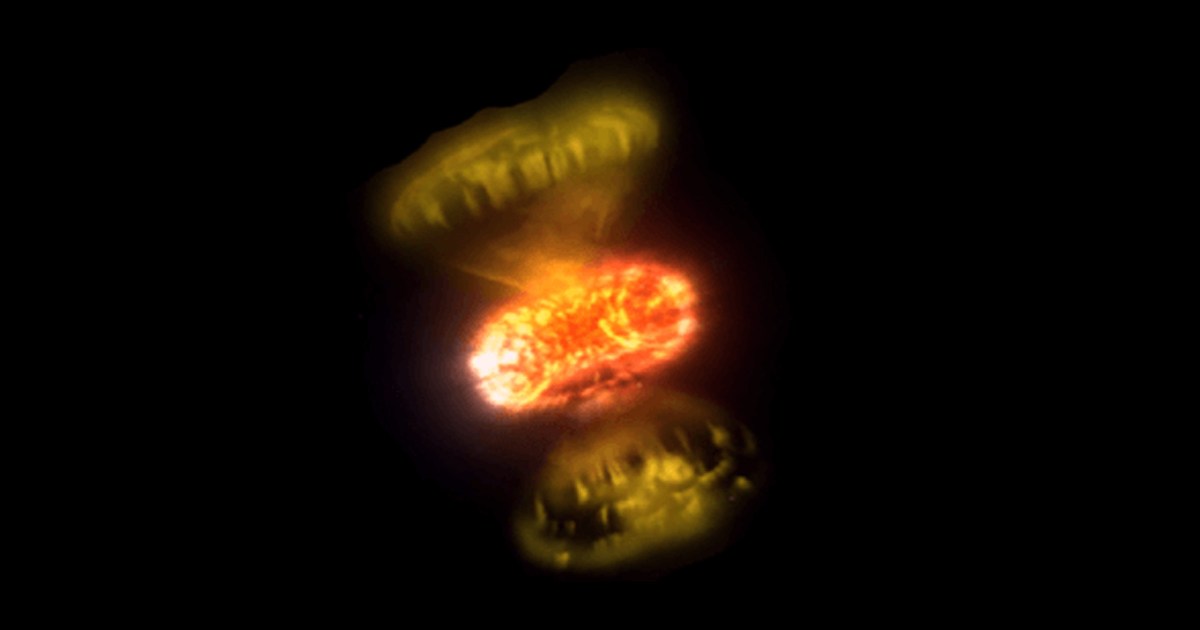
Interferometric observations from the CHARA Array captured two nova eruptions at close temporal resolution, resolving structure previously seen only as unresolved points. A white dwarf siphons hydrogen-rich material from a nearby companion until the accreted layer reaches critical mass and ignites a thermonuclear detonation; the white dwarf survives. These nova blasts release in moments the energy equivalent to roughly 100,000 years of the Sun's output. Prior direct imaging of early eruption stages was limited; the new multi-telescope interference imaging reveals asymmetric, complex unfolding dynamics and enables astronomers to watch the explosion development in real time.
"The images, taken with multiple telescopes at the CHARA Array at Georgia State University, captures a stellar calamity known as a nova, in which the extremely dense remnant of a star that was once like our Sun, called a white dwarf, siphons material from its companion star orbiting dangerously near it, eventually causing a thermonuclear explosion that the white dwarf ultimately survives. The detonation arises once the stripped material - primarily hydrogen - accumulates on the white dwarf's surface and reaches critical mass."
"Novas, in other words, are naturally occurring hydrogen bombs, releasing in mere moments the energy our star emits in roughly 100,000 years."
"These observations allow us to watch a stellar explosion in real time, something that is very complicated and has long been thought to be extremely challenging,"
"Instead of seeing just a simple flash of light, we're now uncovering the true complexity of how these explosions unfold."
Read at Futurism
Unable to calculate read time
Collection
[
|
...
]