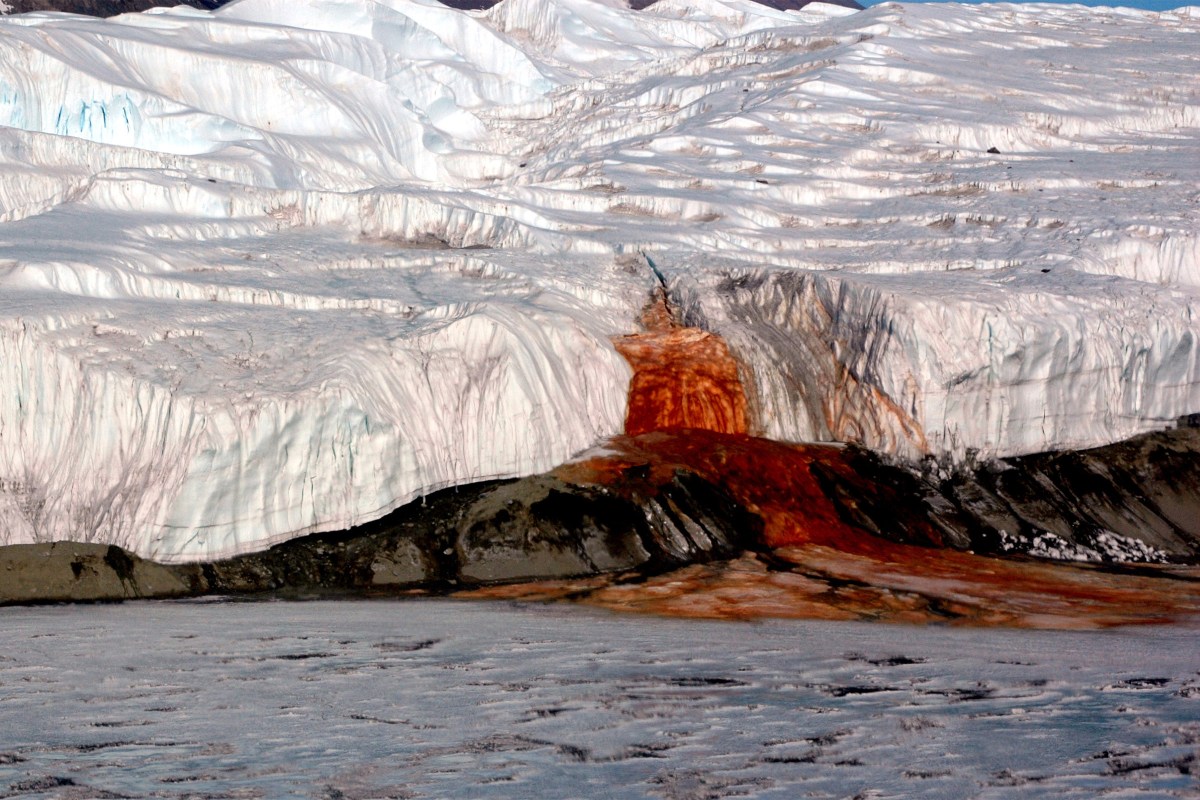
Blood Falls, discovered in 1911 on Taylor Glacier in eastern Antarctica, is a striking red waterfall that has puzzled scientists for over a century. The red coloration originates from iron-rich water sourced from a subglacial lake buried beneath the glacier. Ancient metal-metabolizing bacteria trapped iron particles into nanospheres within this lake. The water's extreme salinity prevents freezing despite Antarctic temperatures. Recent research reveals that glacier weight and movement expel this briny water upward through the glacier, creating the visible red discharge. The iron oxidizes upon exposure to air, producing the distinctive blood-like appearance.
"Originally believed to be caused by microalgae, scientists came to suspect that its color came instead from iron in the water, originating from a subterranean lake, that instantly oxidized when it was expelled and exposed to air. Except this explanation, it turned out, was also a slight red herring."
"More recent work revealed that the iron didn't come in mineral form, but was instead trapped into tiny structures called nanospheres. The iron particles were probably packaged that way by ancient, metal metabolizing bacteria that lived in a lake buried deep beneath the glacier, with the iron coming from the lake bed."
"Lead author Peter Doran, a geoscientist at Louisiana State University, and colleagues suggest it's being expulsed from its subglacial source - the buried, briny lake - due to the weight and movement of the overlying glacier."
Read at Futurism
Unable to calculate read time
Collection
[
|
...
]