The universe’s overall shape is unresolved, even though cosmologists are fairly certain it is flat. Flatness does not determine whether space is infinite or what global topology it has, so space could extend without end or wrap around in ways analogous to a three-dimensional donut surface. Geometry in curved spaces can be inferred from how angle sums behave. On a plane, a triangle’s angles sum to 180 degrees, while on a sphere the sum is greater, and on other curved surfaces it can be less. The same idea applies in three dimensions: the angle sum depends on the curvature of space. Carl Friedrich Gauss studied geometry in curved spaces and is associated with measuring distances and angles between mountain peaks to test whether the geometry was close to flat.
"Cosmologists are now fairly certain that our universe is flat. But that doesn't explain the exact shape of space. It could extend infinitely along the three spatial dimensions or resemble a three-dimensional generalization of a donut's surfaceor take on even wilder forms. The mathematics of flat space is astonishingly versatile, and new research is upending the traditional thinking about the layout of our cosmos."
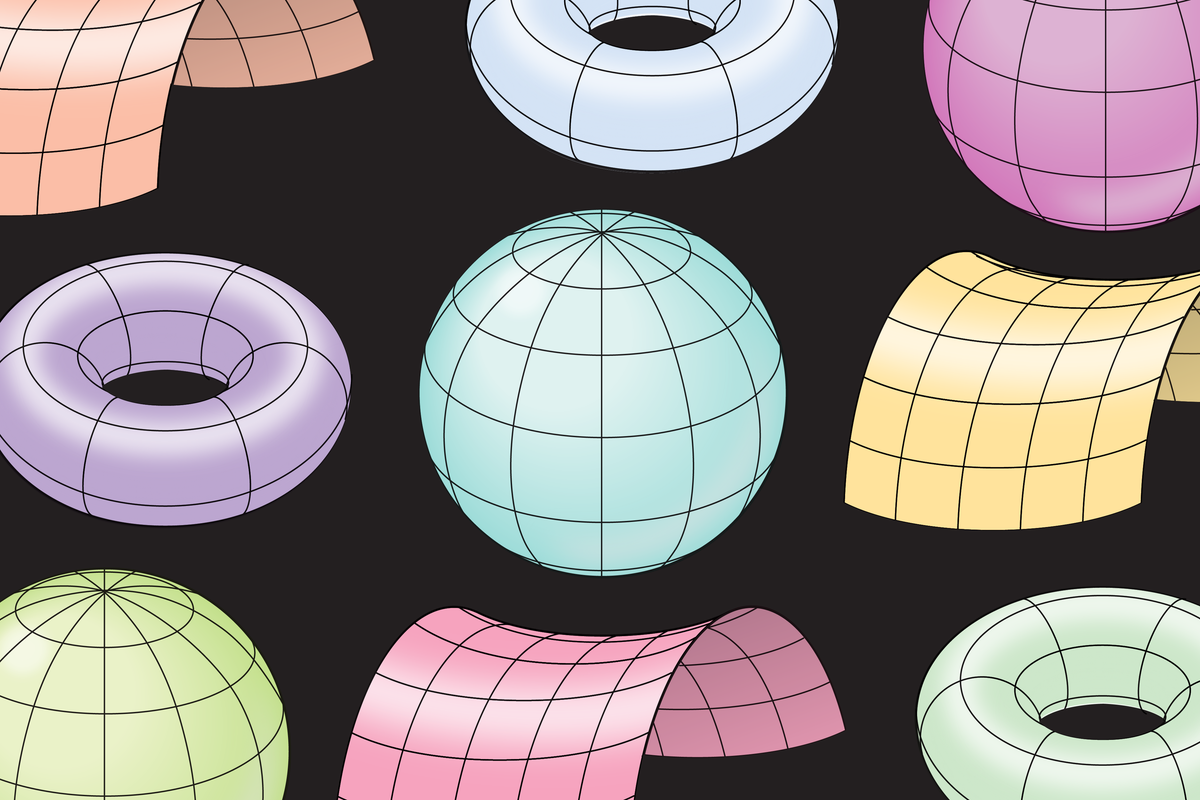
"Carl Friedrich Gauss, a German astronomer who lived in the late 1700s and early 1800s, was one of the first mathematicians to study geometry in curved spaces. He knew, for example, that the sum of the angles of a triangle in a plane is 180 degrees and that it is greater on a sphere. On spherical surfaces, such as that of Earth, an equilateral triangle can consist of three right angles, for instance."
"Other geometries, such as the shape of a Pringles chip, can have angle sums of less than 180 degrees. The same principle applies not only to triangles on 2D surfaces but also in 3D space. Depending on the curvature of space, the sum of the angles can vary. Gauss may have seen the triangle as a good starting point for investigating the shape of the universe, though this is debated."
"He is said to have measured the distances between three German mountain peaks (Hohenhagen, Brocken and Inselberg) and determined their angles. His result: the sum was close enough to 180 degrees that it suggested that there was a fla"
Read at www.scientificamerican.com
Unable to calculate read time
Collection
[
|
...
]