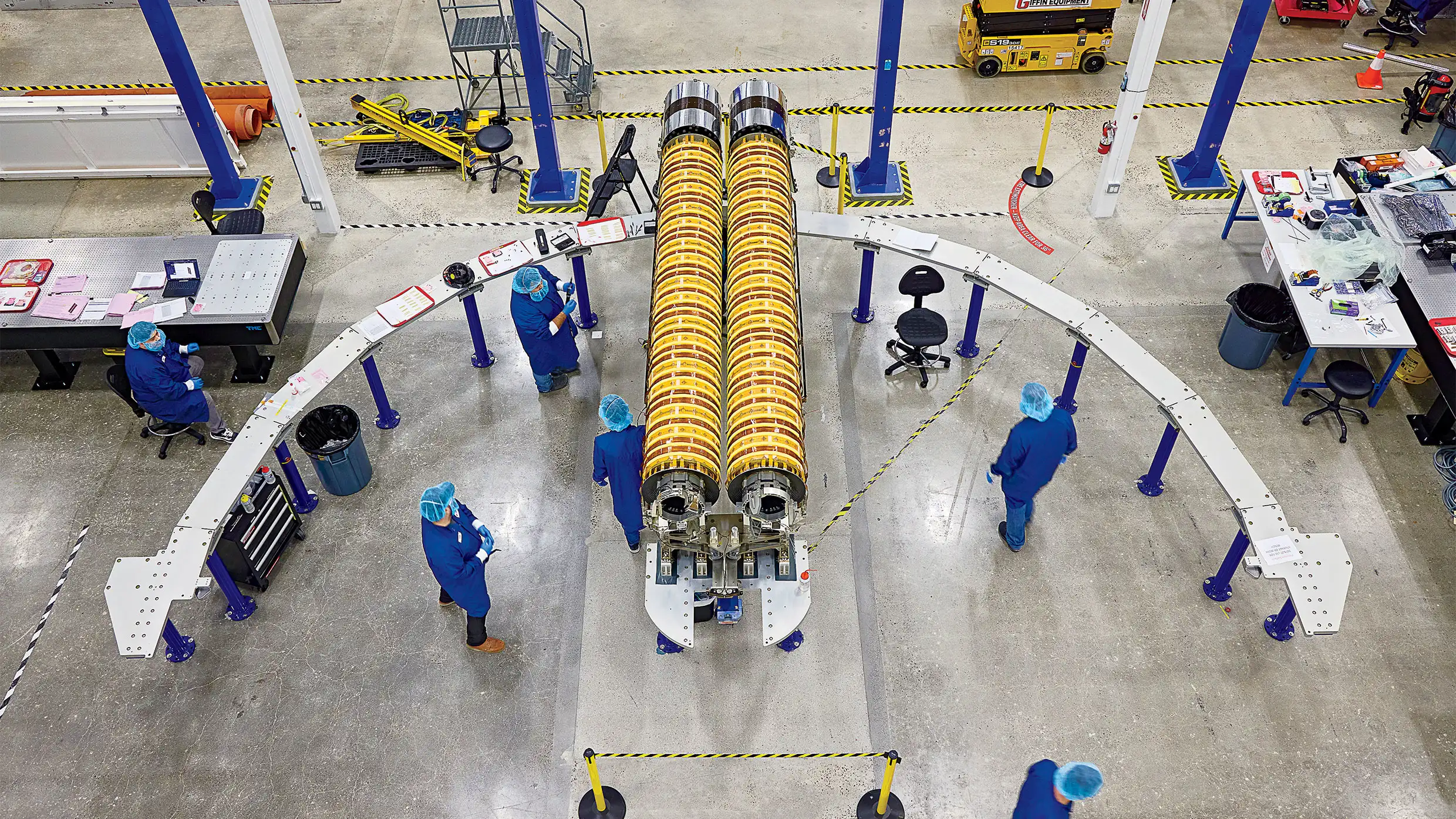
"Gateway's power will come from a pair of blankets of photovoltaic cells, known as Roll-Out Solar Arrays (ROSAs). Each is roughly the size of a football end zone, and together they'll provide 60 kilowatts for 24 hours a day-enough energy to power roughly 50 American homes. But to minimize their profile on the trip out of Earth's atmosphere, the arrays will be launched in a rolled-up state, a pair of sci-fi rugs bound for lunar orbit."
"The Gateway's ROSAs are built by space company Redwire, using tech initially developed by its subsidiary Deployable Space Solutions. "When the arrays get to the Gateway, they'll be attached [to the station] and then roll out," says Mike Gold, a NASA veteran and Redwire's president of civil and international space business."
Gateway is a planned lunar-orbit space station slated to support Artemis IV and V missions and serve as a staging point for Mars missions. Gateway will rely on two Roll-Out Solar Arrays (ROSAs) to supply continuous power. Each array is roughly the size of a football end zone; together they will provide about 60 kilowatts around the clock, roughly the energy needs of 50 American homes. The arrays will launch rolled up inside a rocket fairing and unspool at the station using a flexible boom rather than an electric motor. Redwire built the ROSAs from technology developed by Deployable Space Solutions; Redwire tested roll-out capabilities in July and transferred the panels to Lanteris (formerly Maxar) for prelaunch testing and integration with the station's power and propulsion element.
Read at Fast Company
Unable to calculate read time
Collection
[
|
...
]