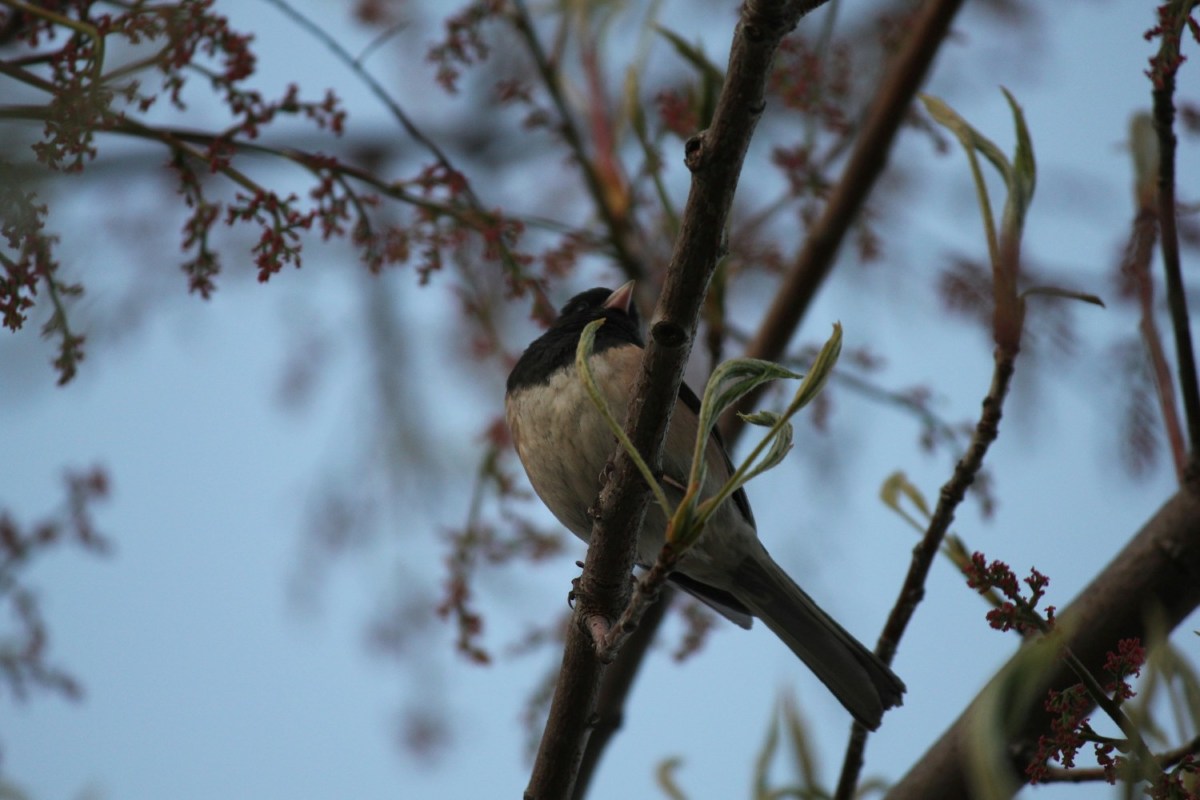
"If you've ever been curious about how wildlife adapt to short-term environmental changes, a recently-published study has big news about what the pandemic did to one of the most ubiquitous birds out there. The species in question is the dark-eyed junco, of which there are 220,000,000 worldwide. A pair of scientists decided to use the pandemic to explore how juncos around the UCLA campus were adapting to a dramatically reduced human population - and thus, a decline in the amount of leftover human food on which the birds could forage."
"The paper, published last month in Proceedings of the National Academy of Sciences, begins with an intriguing premise. Dark-eyed juncos that live near the city have beaks that are differently-shaped than their counterparts living in less developed areas. The scientists found that COVID-era lockdowns had an effect on this, and wrote that "[b]irds that hatched during and soon after COVID-19 restrictions had beaks that resembled those of local wildland birds." Once these restrictions were eliminated, the birds' beaks returned to their conditions prior to the pandemic."
"In their paper, the researchers explored a few potential causes for this. "[W]e speculate that food waste may drive the adaptive evolution of a more generalist bill shape in urban juncos, which rapidly shifts at a population-level in response to resource change," they wrote - though they also noted the remote possibility that more juncos from non-urban populations were drawn to urban spaces during the pandemic. "[I]t's amazing to be able to see evolution happening before your eyes, and to see a clear human effect changing a living population," one of the paper's authors, UCLA professor Pamela Yeh, said in a statement."
Dark-eyed juncos number roughly 220,000,000 worldwide. Urban juncos exhibit beak morphology different from non-urban counterparts. COVID-19 lockdowns around UCLA reduced human presence and leftover food, coinciding with juveniles hatched during restrictions developing beaks similar to local wildland birds. After human activity resumed, beak morphology shifted back toward pre-pandemic urban forms. Food-waste availability is proposed to drive adaptive evolution toward a more generalist bill shape in urban juncos, producing rapid population-level shifts in response to resource change. An alternative explanation is temporary immigration of non-urban juncos into urban areas during the pandemic.
Read at InsideHook
Unable to calculate read time
Collection
[
|
...
]