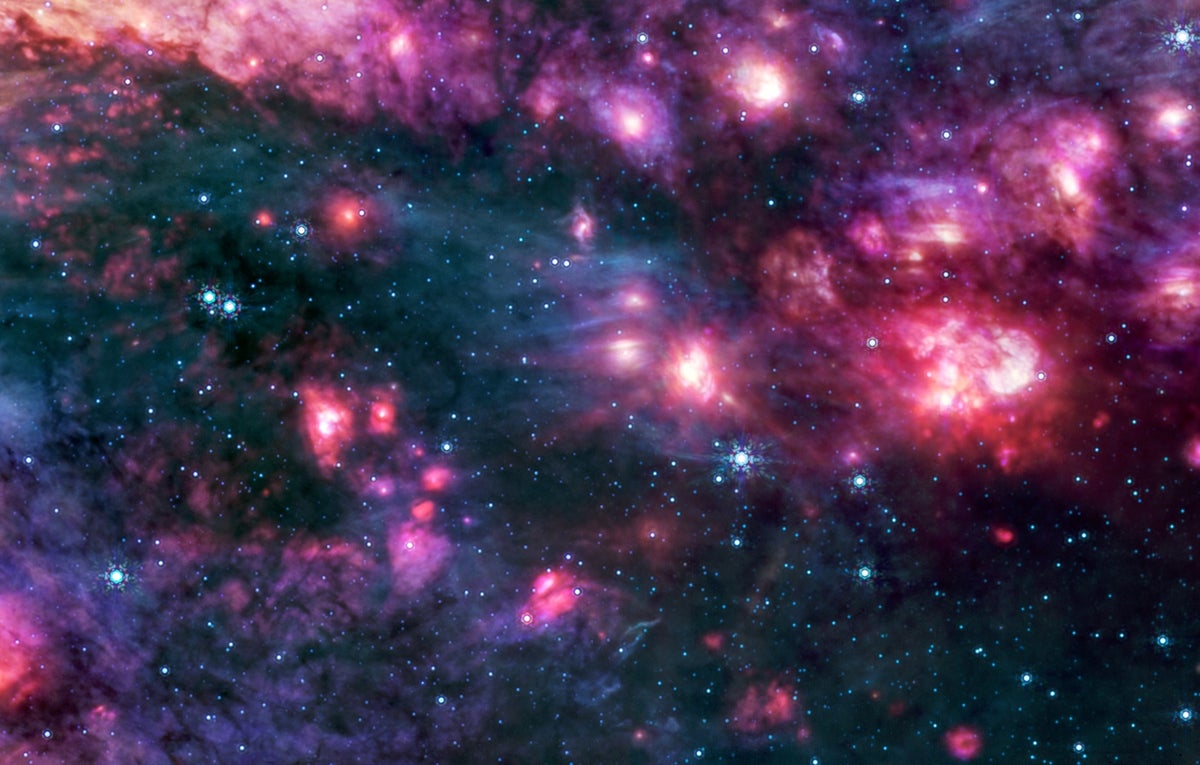
"Supermassive black holes are mysterious bodies. Scientists aren't entirely sure how these beating hearts at the centers of most large galaxies formed. That includes Sagittarius A* (Sgr A*), the supermassive black hole at the center of our own Milky Way galaxy. Now a new preprint study is shedding light on Sagittarius A* by studying what happens as material falls toward the black hole."
"Typically, as dust, gas and other material sink toward a supermassive black hole, the black holes emit an absolute torrent of light, says Steve DiKerby, a postdoctoral researcher at the department of physics and astronomy at Michigan State University and co-author of the new paper. Sagittarius A*, however, is pretty dim. It's emitting only a tiny trickle of radiation, DiKerby says."
"Rather DiKerby and his colleagues' work suggests that the disk of material swirling around Sagittarius A* once emitted much, much brighter x-raysas much as 10,000 times brighter than those it emits today. Incredibly, that may have been the case as recently as a few hundred years ago, the research suggests. The findings were presented at a meeting of the American Astronomical Society earlier this month and have been accepted for publication in Astrophysical Journal Letters."
XRISM observations of material falling toward Sagittarius A* reveal X-ray signatures indicating that the accretion disk emitted X-rays up to 10,000 times brighter a few hundred years ago. Typical accretion onto supermassive black holes produces intense radiation, yet Sagittarius A* currently emits only a faint trickle of radiation. The bright past implies that accretion onto the Milky Way’s central black hole was episodic and reached much higher luminosities in recent centuries. That episodic brightening can explain observed high-ionization features in the Galactic center environment. The new X-ray evidence constrains the recent accretion history and informs models of black hole feeding and nearby gas dynamics.
Read at www.scientificamerican.com
Unable to calculate read time
Collection
[
|
...
]