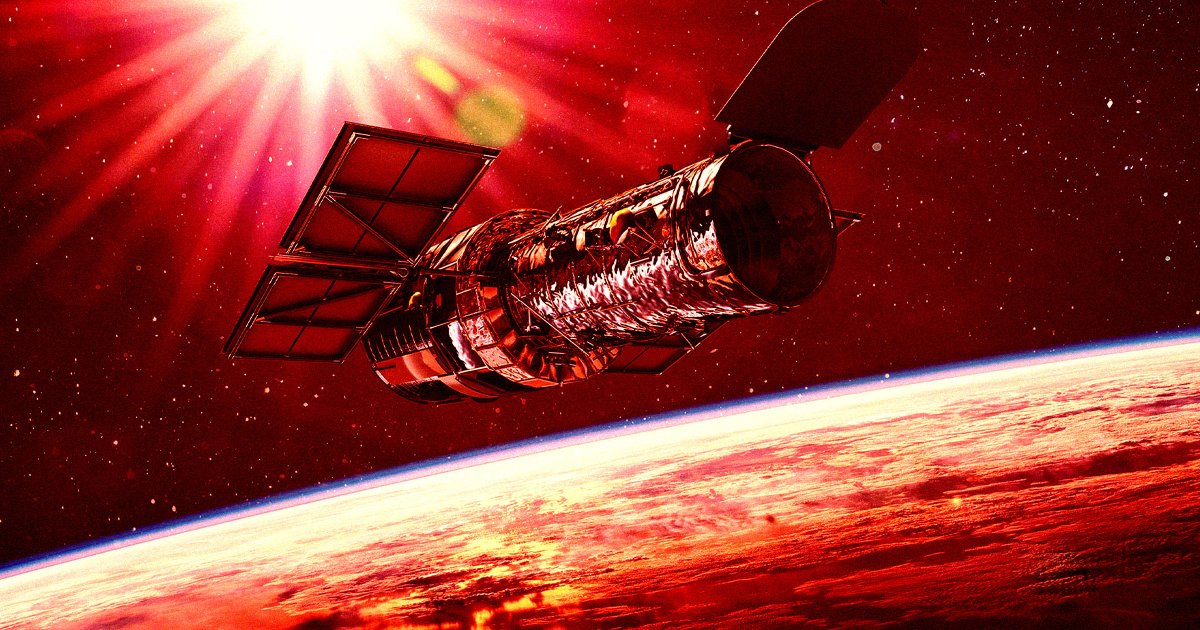
NASA's Hubble Space Telescope, launched 36 years ago and operational two decades beyond its expected lifespan, faces imminent deorbit due to orbital decay. The observatory has endured multiple system failures including safe mode activations, computer glitches, and gyroscope breakdowns. Its altitude has declined from approximately 340 miles to 300 miles between 2020 and 2026, representing accelerated decay compared to historical rates. Harvard astronomer Jonathan McDowell's analysis suggests potential deorbit before 2030, contradicting NASA's projection of mid-2030s. NASA plans to attach a propulsion module enabling either controlled reentry into the South Pacific Ocean or orbital boost to extend Hubble's operational life.
"For decades, Hubble has circled our planet in a circular low-Earth orbit at an altitude of approximately 340 miles. But how much longer it will be able to hang on has become increasingly uncertain. According to a graph posted on Bluesky by Harvard astronomer and space tracker extraordinaire Jonathan McDowell, the historic artifact could deorbit sooner than expected, possibly even before 2030."
"The visualization shows its altitude plunging from around 330 miles to just 300 miles between 2020 and 2026, a major decline compared to more steady downward shifts since the late 1990s - a "death spiral," in the reckoning of The Register."
"A propulsion module will eventually be attached to the telescope to complete either a controlled reentry into the South Pacific Ocean, or to boost Hubble into a much higher orbit to keep the inoperative telescope aloft for several more decades."
Read at Futurism
Unable to calculate read time
Collection
[
|
...
]