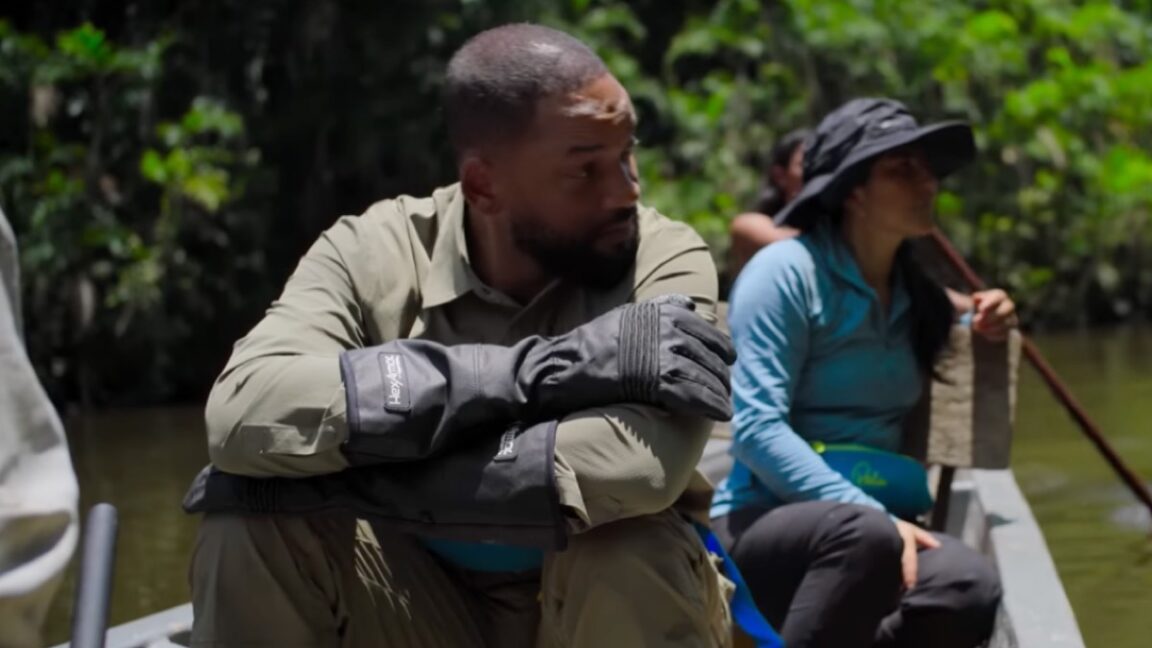
"Along with venom expert Bryan Fry, we follow Smith's journey by boat with a team of indigenous Waorani guides, scouring the river banks for anacondas. And they find one: a female green anaconda about 16 to 17 feet long, "pure muscle." The Waorani secure the giant snake-anacondas aren't venomous but they do bite-so that Fry (with Smith's understandably reluctant help) can collect a scale sample for further analysis. Fry says that this will enable him to determine the accumulation of pollutants in the water."
"That and other collected samples also enabled scientists to conduct the genetic analysis that resulted in the declaration of a new species: the northern green anaconda ( Eunectes akayama, which roughly translates to "the great snake"). It is genetically distinct from the southern green anaconda ( Eunectes murinus); the two species likely diverged some 10 million years ago. The northern green anaconda's turf includes Venezuela, Colombia, Suriname, French Guyana, and the northern part of Brazil."
"Smith's time in the Amazon also brought the arachnophobic actor face to face with a giant tarantula while scientists extracted the venom. His further adventures brought him to the South Pole, where he trekked across frigid ice fields; to the Himalayas, where he trekked to a small village in Bhutan; to the Pacific Islands to record a lost native language; to the Kalahari desert, where he joined the hunter-gatherer San people on a hunt; and to the North Pole, where he joined an expedition to dive under the ice to collect scientific samples."
Scientists announced in 2024 the discovery of a new species of giant anaconda found during a 2022 Amazon expedition. The expedition included a National Geographic camera crew and actor Will Smith, who joined venom expert Bryan Fry and Waorani guides to search river banks. The team captured a 16–17 foot female green anaconda and collected a scale sample to analyze pollutant accumulation. Genetic analysis of collected samples identified the northern green anaconda, Eunectes akayama, as distinct from the southern green anaconda, with a likely divergence about 10 million years ago and a northern South American range.
Read at Ars Technica
Unable to calculate read time
Collection
[
|
...
]