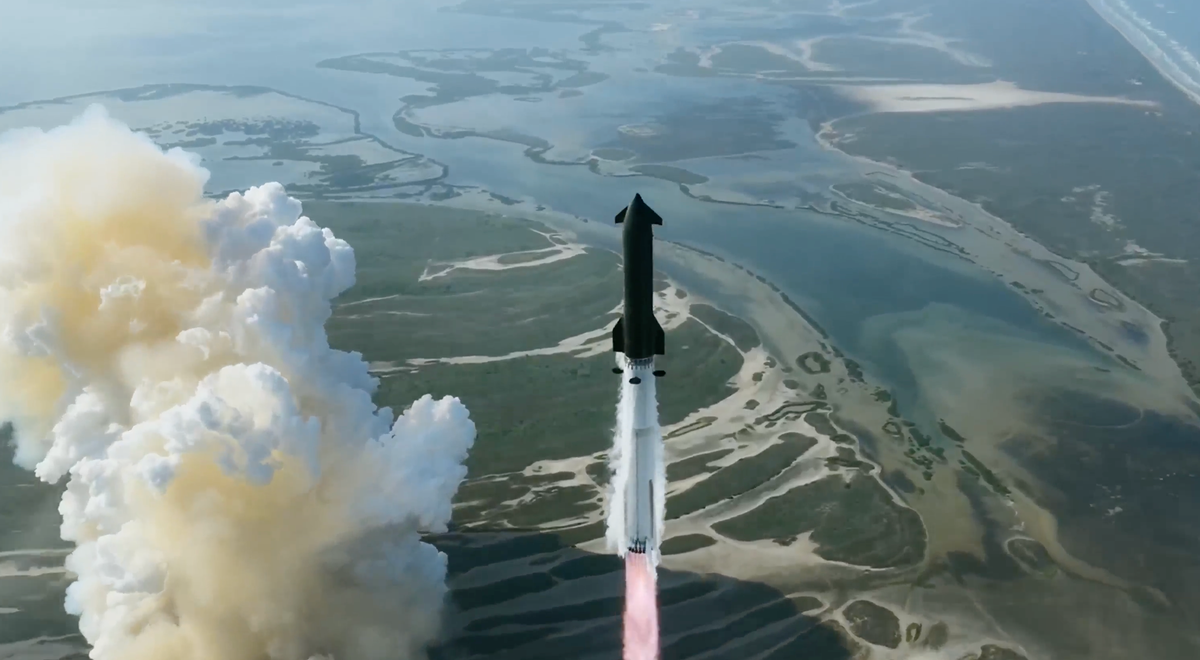
SpaceX launched the latest, largest Starship on Friday as the first test of Starship Version 3 in seven months. The fully stacked vehicle measured 408 feet tall and produced 18 million pounds of thrust, with a design intended for full reusability. During ascent, one of 33 booster engines did not light as expected, but the flight continued. After a few minutes, the booster separated and splashed down in the Gulf of Mexico as planned. Starship then continued upward with one of its six engines also experiencing an issue that could affect mission scope. After booster separation, Starship deployed 20 dummy Starlink satellites at about 195 kilometers and two operational satellites to scan the heat shield and send image data back to Earth. Reentry is planned to include landing maneuvers such as a flip.
"SpaceX on Friday launched the latest and largest version of Starship. Lifting off at around 6:30 P.M. EDT, the flight is the first test of Starship Version 3 (V3). This is the twelfth Starship test and the first demonstration of the rocket in seven months. Fully stacked with its booster, the rocket is 408 feet (124 meters) tall and packing 18 million pounds of thrust, it is the tallest and most powerful rocket ever built. The entire vehicle is designed to be reusable, but SpaceX is not attempting to recover the booster or the rocket after this test."
"In the initial stage of the flight, one of the 33 engines did not light as expected, but it continued on its ascent. After a couple of minutes, the booster separated with Starship, falling back to Earth to splash down in the Gulf of Mexico as planned a few minutes later. Starship continued on, with one of its six engines also outan issue that SpaceX said could change the scope of the mission. Still, as it ascended, whoops and cheers could be heard from SpaceX's ground team."
"The test flight aimed to show that Starship V3 can successfully launch, separate from its booster and then splash down in the Indian Ocean. Once separated from its booster, the spacecraft deployed 20 dummy Starlink Internet satellites at an altitude of around 195 kilometers, as well as two operational satellites that are designed to scan Starship's heat shield and beam images back to Earth for further analysis. This image shows a view of Starship in space, as seen by one of those satellites."
"On reentry, the spacecraft is set to perform a series of landing maneuvers, including a flip. NASA administrator Jared"
Read at www.scientificamerican.com
Unable to calculate read time
Collection
[
|
...
]