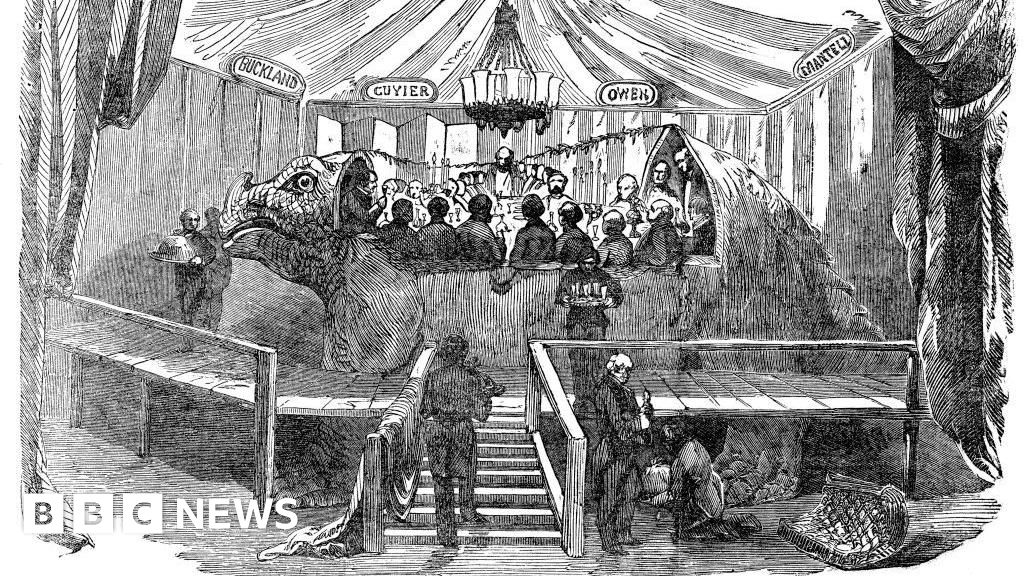
"Benjamin Waterhouse Hawkins was a natural history artist who envisioned a grand experiment - bringing to life the "dry bones or oddly shaped stones" found in the British Museum and introducing the masses to the emerging science of palaeontology. By reconstructing these long-extinct animals, he hoped to "render the appearance and names of the ancient inhabitants of our globe" such that they became as familiar to people as other beasts."
"Hawkins's plan was to launch his dinosaur sculptures to the world, and encourage people to visit the newly relocated Crystal Palace and its park - so a reporter or two were also invited, along with local bigwigs, owners and investors in the exhibition centre. He also had a good eye for a publicity stunt, and one of the invitees was Herbert Ingram, publisher of the Illustrated London News - a paper with a circulation of more than 150,000 - which would produce a full report on the evening alongside a large illustration."
Benjamin Waterhouse Hawkins was a natural history artist who reconstructed long-extinct animals from bones and stones to render their appearance and names for the public. He created life-size dinosaur sculptures for the Crystal Palace and used publicity stunts to promote the exhibition. He invited twenty distinguished men to a New Year's Eve dinner held in the mould of the iguanodon model. Guests included leading scientists such as Richard Owen, Edward Forbes, John Gould and Joseph Prestwich, and a reporter from the Illustrated London News. The dinner proceeded despite snow and ice, with the iguanodon as the largest model in the menagerie.
Read at www.bbc.com
Unable to calculate read time
Collection
[
|
...
]