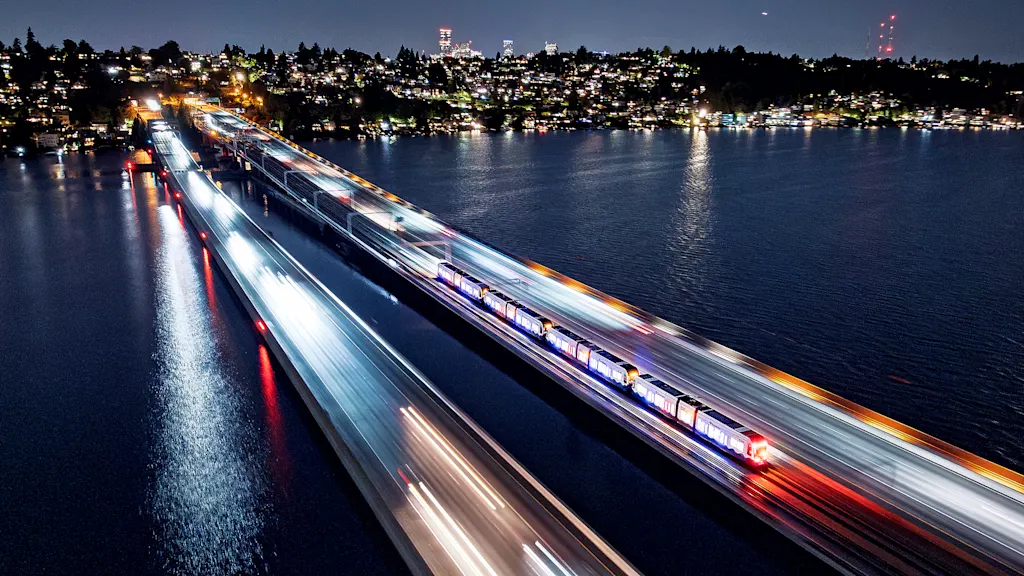
"If you live in Seattle and work at Amazon or Meta in nearby Bellevue, you probably drive to work. But by the end of next month there will be another option for commuters: the world's first light rail line running on a floating bridge. Right now, drivers cross Lake Washington-the long lake between Seattle and eastern suburbs like Bellevue-use one of three floating bridges."
"First, since the bridge doesn't have columns like a typical bridge, it moves. "It's like a ship that's been anchored to the floor of the lake," says Brian Holloway, deputy director of engineering oversight at Sound Transit, the local transit agency. Near each end of the bridge, where the floating section connects to fixed parts of the bridge over land, hinge-like expansion joints let the bridge move as the water level changes or wind and waves slightly shift the structure."
"Driving over the bridge in a car, you don't notice the changes as the expansion joints move. But "those geometric changes would have a very significant effect on rail," says Matthew Barber, a supervising engineer working on the project at WSP. To make light rail feasible, engineers designed a new solution: "track bridges" that support a section of rail on a structure with bearings that let the bridge move freely while keeping the rail steady. "The rail bends in a very smooth way," Barber says."
A light rail line will run on a floating bridge across Lake Washington, providing a commuter connection between Seattle and Bellevue. Lake Washington's depth and width necessitated pontoon-based floating bridges rather than conventional columns. The floating section moves with changing water levels, wind and waves; hinge-like expansion joints connect the floating section to fixed land spans. Such movements would significantly affect rail alignment. Engineers developed 'track bridges' that carry rail on structures with bearings, allowing the bridge to move independently while keeping tracks steady. Bearings are similar to those used in seismic retrofits. Weight presented a further challenge because pontoons were not designed to support light rail.
Read at Fast Company
Unable to calculate read time
Collection
[
|
...
]