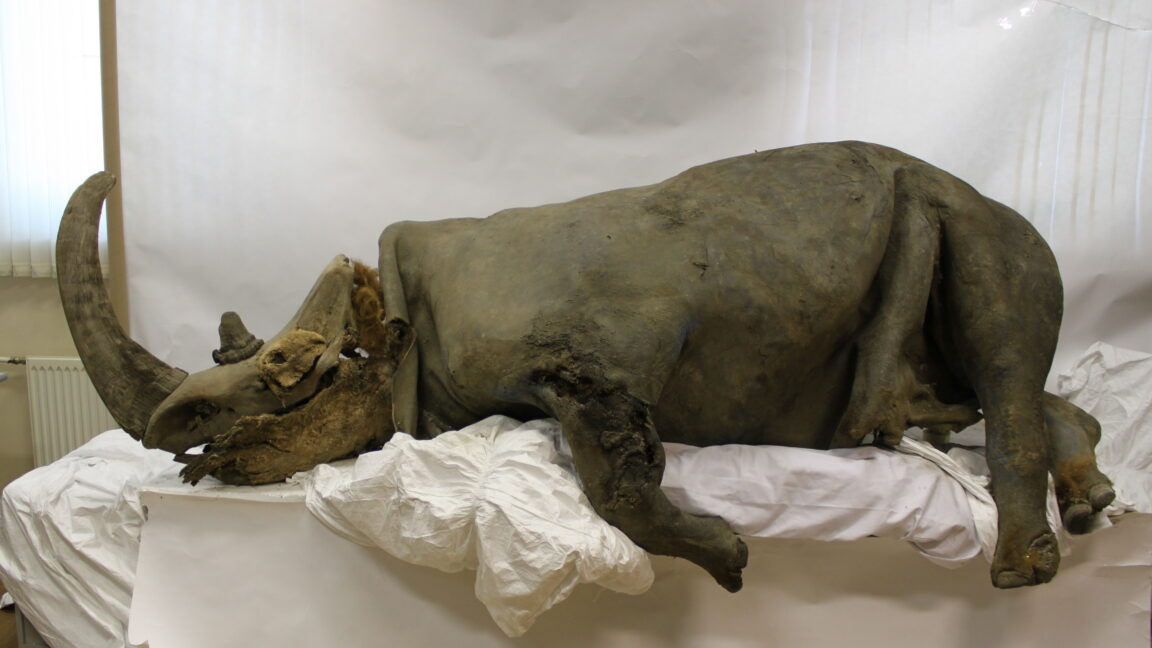
"So what counts as a stable population? In the genome of a 49,000-year-old woolly rhino from a few hundred miles east in Rakvachan, Siberia, Guðjónsdóttir and her colleagues found clues about the species' even more ancient history. Big changes in population size, among other events, can leave traces in the genome, and the researchers used those to estimate that between 114,000 and 63,000 years ago, the woolly rhino population dropped sharply, from about 15,600 to about 1,600."
"Those numbers refer to what ecologists call the "effective population," which means the number of rhinos breeding and contributing to the group's gene pool (so there would have been more than 1,600 running around, but not all of them were reproducing). After 63,000 years ago, the woolly rhino population seems to have leveled out. According to ecologists, an effective population of 1,600 rhinos would have been more than enough to keep the species thriving."
Genomic analysis of a 49,000-year-old woolly rhino from Rakvachan, Siberia, reveals an ancient population bottleneck. Between roughly 114,000 and 63,000 years ago, the effective population declined from about 15,600 to about 1,600 breeding individuals. After 63,000 years ago the effective population appears to have stabilized. Effective population refers to the number of individuals contributing genes, which is lower than total census numbers. An effective population of 1,600 would have been sufficient to maintain species viability. However, smaller populations with shrinking ranges become more susceptible to environmental change, disasters, disease, inbreeding, loss of genetic diversity, and genetic drift, potentially creating a vicious extinction cycle. A single individual was found eaten by a wolf despite regional persistence.
Read at Ars Technica
Unable to calculate read time
Collection
[
|
...
]