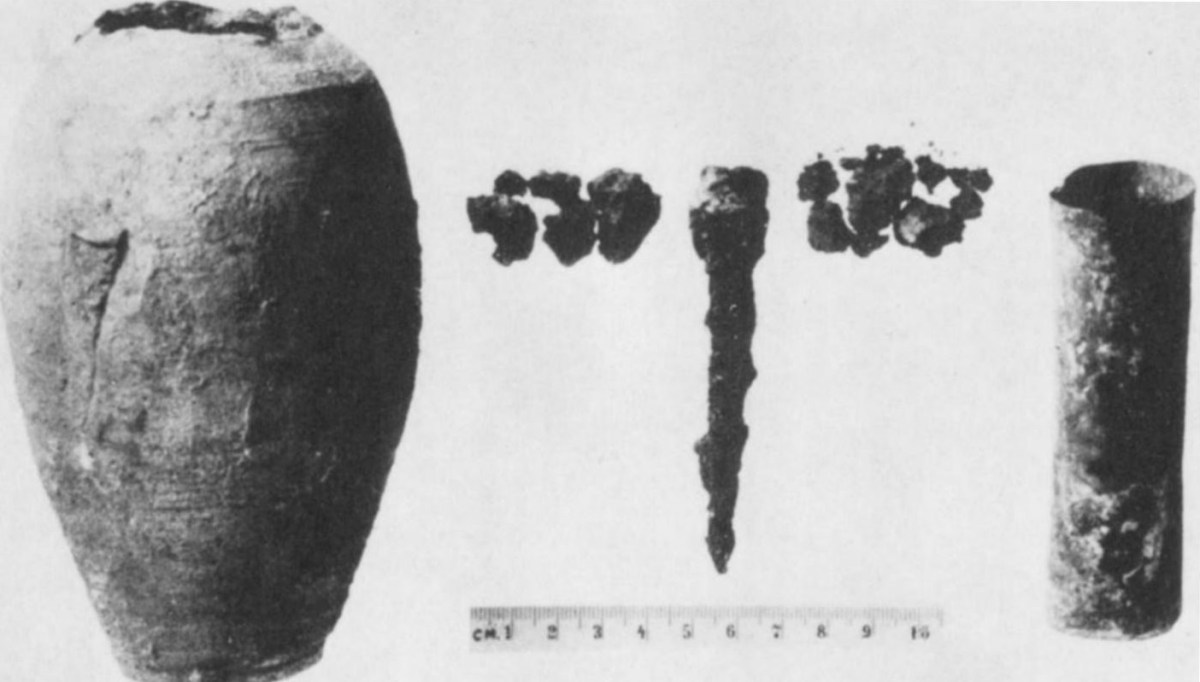
"Dubbed the "Baghdad battery," it's believed to have originally been a clay jar housing a copper vessel, at the center of which was an iron rod. This arrangement, either by coincidence or design, could've allowed it to function as a primitive galvanic cell, some archaeologists argue - a primitive energy storage device pioneered in the Western world by Alessandro Volta, after whom the "volt" was named."
"Bazes's reconstruction argues otherwise. His experiments suggests that the clay jar's porous exterior acted like a separator between an electrolyte, perhaps lye, and air, which connected with the copper vessel to create an outer cell. Meanwhile, the iron rod inside the copper vessel acted as an inner cell, creating an electrical series that could've produced 1.4 volts of electricity - approximately the same voltage of a modern AA battery."
A fragmentary artifact discovered in Iraq nearly a century ago appears to have been a clay jar containing a copper vessel with an iron rod centered inside. The configuration can form a primitive galvanic cell if an electrolyte is present. The original object has been lost since 2003, requiring reconstructions from records. Reconstruction experiments indicate the jar's porous clay exterior could act as a separator between an electrolyte, possibly lye, and air to form an outer cell while the iron-copper pair formed an inner cell. The combined cells could have produced about 1.4 volts, roughly a modern AA battery's voltage.
Read at Futurism
Unable to calculate read time
Collection
[
|
...
]