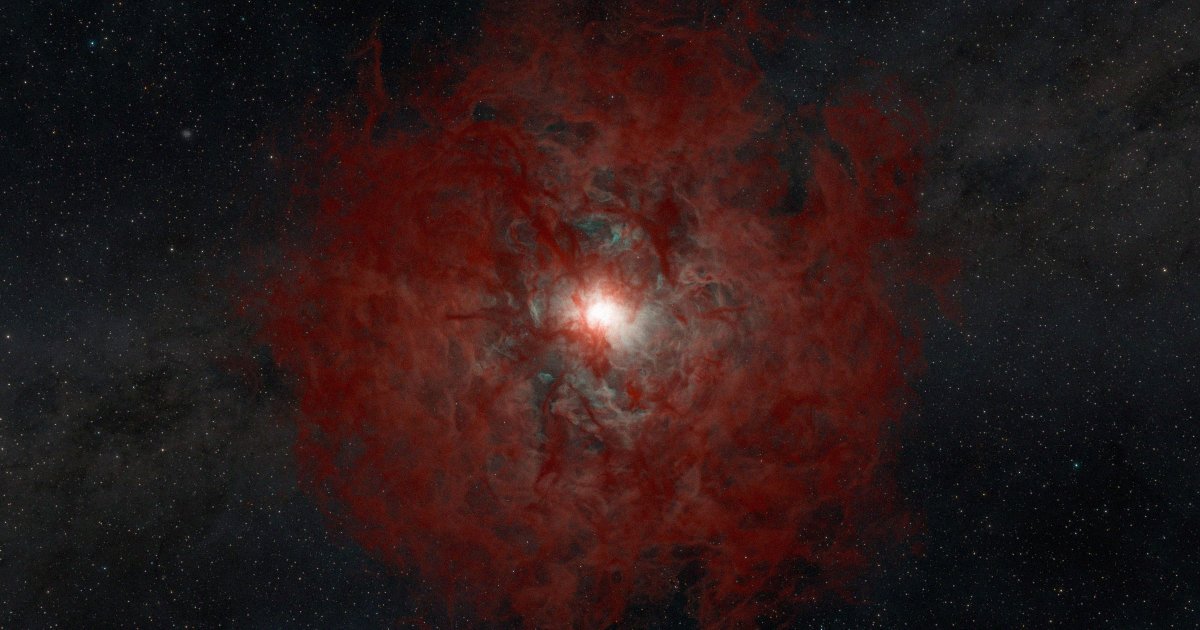
"The end of a star's life can be an extremely violent event. Once it runs out of fuel, its core collapses, and if its original mass is large enough, it can erupt in a supernova, a runaway nuclear fusion event that can release as much energy as the Sun will produce over its entire lifespan of roughly ten billion years. The remains are either a neutron star, an immensely dense lump of matter, or a black hole."
"Columbia University astronomer Kishalay De and his colleagues analyzed 15 years' worth of data collected by NASA's NEOWISE spacecraft as part of an effort to measure changes in the amount of infrared radiation millions of stars emit over the years. One star, dubbed M31-2014-DS1, stood out like a sore thumb - brightening in 2015, fading roughly a year later, and eventually disappearing from view, even in optical light."
""In a dying massive star, the core collapses to form a compact object," the article reads. "Simultaneously, the outer layers can be ejected at high speed, which is observed as a supernova." "Theory predicts that sometimes the ejection speed is too low to escape the gravitational field, so the outer layers fall back over several years, producing no supernova and a more massive compact object," the researchers wrote."
Analysis of 15 years of NASA NEOWISE infrared data revealed one star in Andromeda, M31-2014-DS1, brightened in 2015, faded about a year later, and eventually vanished even in optical light. The object was formerly among the galaxy's most luminous stars. Massive stars undergo core collapse when they exhaust fuel; successful ejection of outer layers produces a supernova, while insufficient ejection allows outer layers to fall back over years, producing no visible supernova and forming a more massive compact object. The observed disappearance matches the predicted signature of a failed supernova leading to direct black hole formation.
Read at Futurism
Unable to calculate read time
Collection
[
|
...
]