"Kangaroos and wallabies belong to a class of animals called macropods, with unique form and style of movement. Their four limbs and tail all contact the ground at slow speeds, while they use a hopping gait at higher speeds. Typically, high-speed movements are more energy-intensive than slow-speed motion, but the opposite is true for macropods like kangaroos; somehow the hopping speed and energy cost become uncoupled."
"To investigate their hypothesis, the authors used 3D motion capture and data from force plates to create a 3D musculoskeletal model to analyze the motions of red and grey kangaroos, focusing on how body mass and speed influence three factors during hopping: hindlimb posture, efficiency of movement and associated tendon stress; and the ankles. This revealed that kangaroos adjust their posture so that the hindlimbs are more crouched while hopping, with the ankle joint doing most of the work per hop."
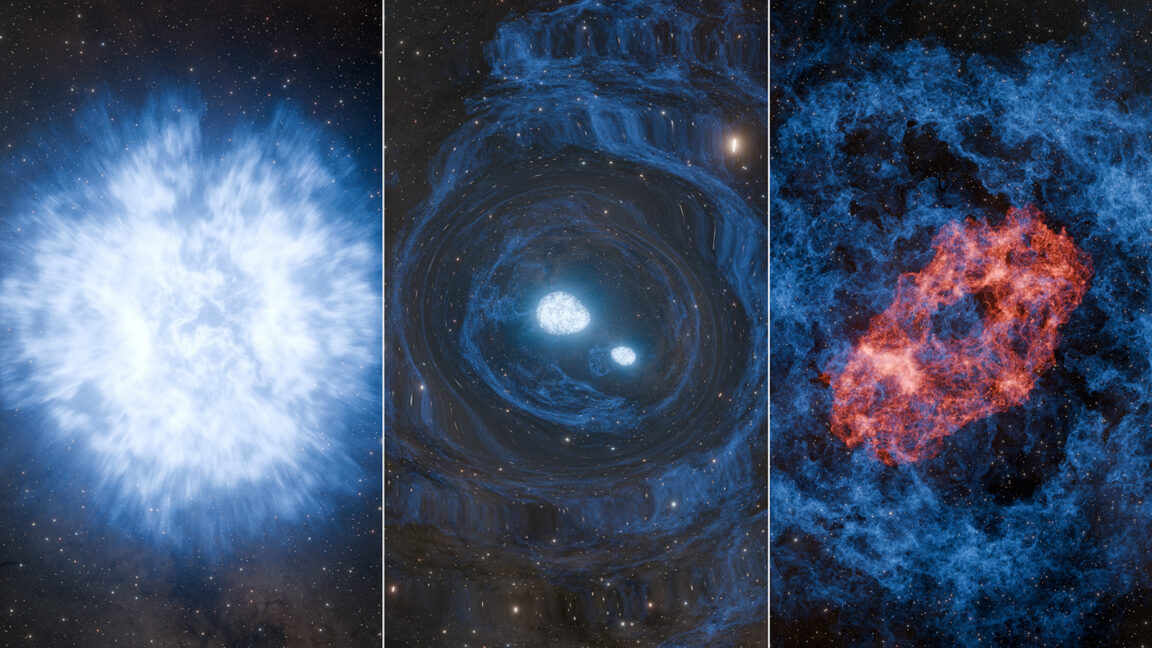
Multiple recent discoveries span astrophysics, archaeology, paleontology, and biomechanics. A double-detonating "superkilonova" and Roman burials using liquid gypsum are reported alongside a fossilized bird that choked on rocks and recovery of an ancient seafarer's fingerprint. Researchers also proposed a solution to a dark matter puzzle previously posed in fiction. In biomechanics, 3D motion capture and force-plate data were used to build a 3D musculoskeletal model of red and grey kangaroos to test how body mass and speed affect hindlimb posture, movement efficiency, tendon stress, and ankle function. Kangaroos adopt a more crouched hindlimb posture at higher speeds, shifting work to the ankle and increasing energy absorption and hopping efficiency.
Read at Ars Technica
Unable to calculate read time
Collection
[
|
...
]