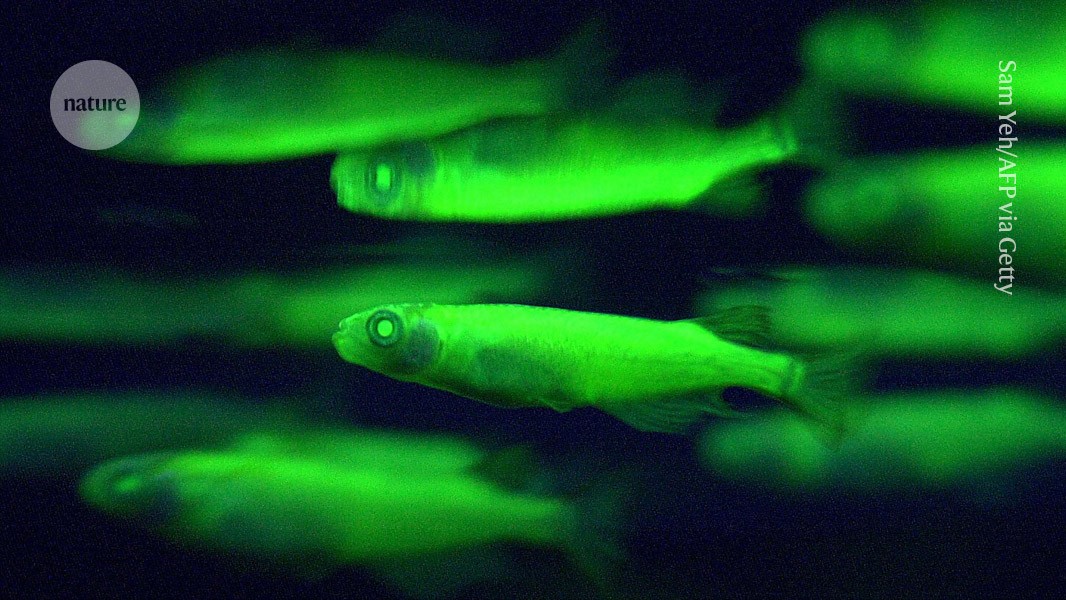
"Researchers have engineered magnetically controlled fluorescent proteins that can be remotely dimmed and brightened in cells and living animals. The hope is that these proteins' magnetic sensitivity - a quantum effect - can be exploited to develop remote-controlled biosensors, or even therapies that can be turned on and off when needed. "We want to make a toolbox of magnetically remote-controlled protein functions," says Andrew York, a physicist at the Chan Zuckerberg Biohub in San Francisco, California."
"The effect was small - the brightness of GFP dimmed by about 1% near a magnet - so the researchers engineered a more responsive protein, called MagLOV, the fluorescence of which dims by half or more in the presence of a magnet. To explore how best to harness MagLOV's properties, a team led by biophysicist Gabriel Abrahams and bioengineer Harrison Steel, both at the University of Oxford, UK, tested the basis for its sensitivity to magnetic fields."
Magnetically controlled fluorescent proteins allow remote dimming and brightening of fluorescence in cells and living animals. Green fluorescent protein (GFP) shows a small brightness decrease near a weak magnet. An engineered variant, MagLOV, exhibits fluorescence dimming by about 50% or more in magnetic fields. A magnetic-resonance effect alters the quantum properties of an electron pair in the protein, enabling brightness manipulation with combinations of magnetic fields and radio waves in Escherichia coli. MagLOV and related proteins have been applied in bacteria and demonstrated with similar proteins in nematode worms. Magnetic sensitivity offers potential for remote-controlled biosensors and switchable therapies.
Read at Nature
Unable to calculate read time
Collection
[
|
...
]