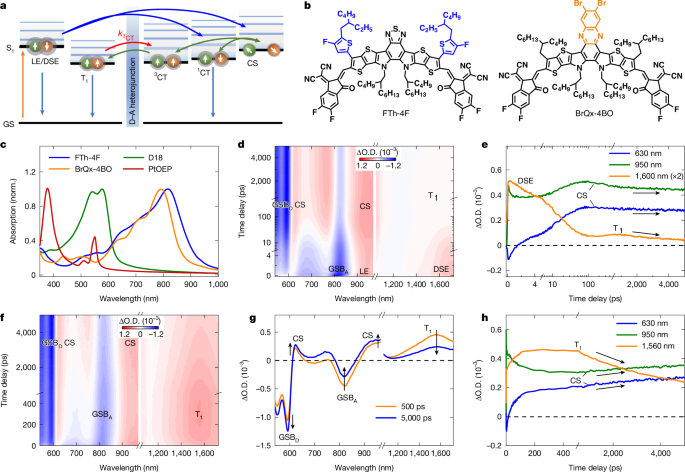
"Non-geminate recombination in organic photovoltaics forms low-energy spin-triplet excitons that result in irreversible, non-radiative relaxations. This study shows that T1 excitons can be redissociated through the interfacial charge-transfer state to form free carriers."
"The distribution of orbitals in the molecule and exciton delocalization in aggregates affect the singlet-triplet energetics of the acceptor, making the traffic between T1 and the spin-triplet charge-transfer state controllable."
"By introducing this acceptor as a ternary component into other host OPV systems, we manage to recover the triplet-mediated losses and improve OPV efficiencies by maximizing the number of extractable photocarriers."
Non-geminate recombination in organic photovoltaics leads to low-energy spin-triplet excitons that cause irreversible relaxations. An OPV system with a non-fullerene acceptor shows that these excitons can be redissociated into free carriers. This process is influenced by the distribution of molecular orbitals and exciton delocalization. By incorporating this acceptor into other OPV systems, triplet-mediated losses can be recovered, improving overall efficiency. This research enhances the understanding of OPVs and demonstrates a method to convert low-energy excitons into usable charges for energy generation.
#organic-photovoltaics #spin-triplet-excitons #free-carriers #energy-efficiency #non-fullerene-acceptor
Read at Nature
Unable to calculate read time
Collection
[
|
...
]