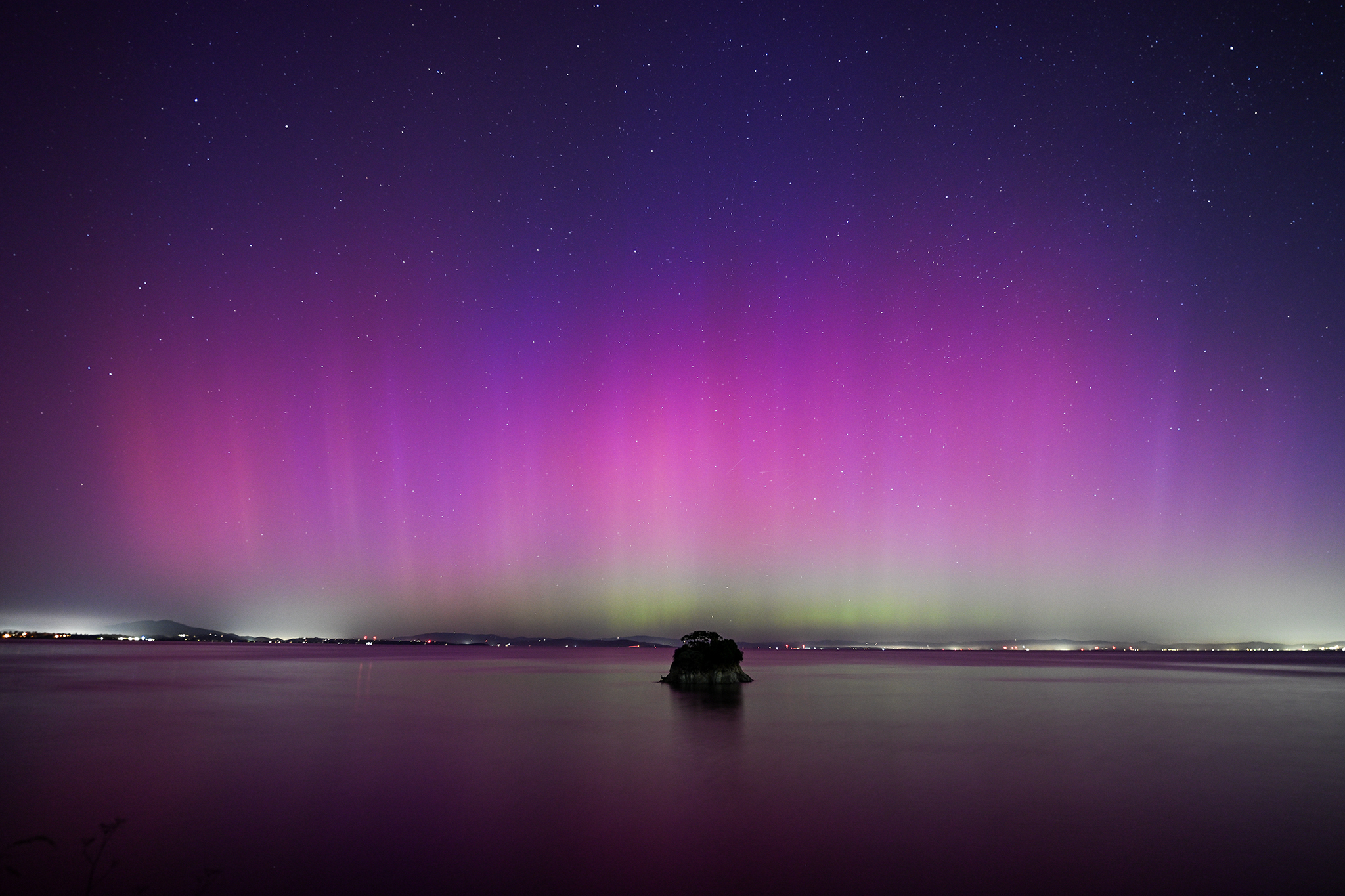
A severe S4 solar radiation storm, the most intense since October 2003, struck Earth after a coronal mass ejection slammed into the planet. Charged particles accelerated by the eruption traveled rapidly from the sun and penetrated Earth's magnetic shield. Those particles were guided toward polar regions and collided with atmospheric gases, producing visible auroras and expanding the auroral zone farther south than usual. Rural and less light-polluted areas of the North Bay and Northern California, including Mount Saint Helena and Lake Mendocino north of Ukiah, reported sightings. Cameras captured the aurora as displays peaked Monday night and viewing conditions were expected to weaken by Tuesday night.
"The agency said the storm intensified after a coronal mass ejection, or CME - a massive eruption of magnetized plasma from the sun - slammed into Earth. Solar radiation storms occur when solar eruptions accelerate charged particles, primarily protons, to extremely high speeds. According to the agency, those particles can travel the estimated 93 million miles from the sun to Earth in minutes."
"Dial Hong, a meteorologist with the National Weather Service's Bay Area office, told SFGATE that the Space Weather Prediction Center said that aurora sightings were concentrated in rural and less populated areas of the North Bay and Northern California, where darker skies and less light pollution made the phenomenon easier to see. "With areas like Mount Saint Helena, we saw cameras capture the aurora," Hong said, adding that the agency also received reports of aurora sightings in the Lake Mendocino area north of Ukiah."
Read at SFGATE
Unable to calculate read time
Collection
[
|
...
]