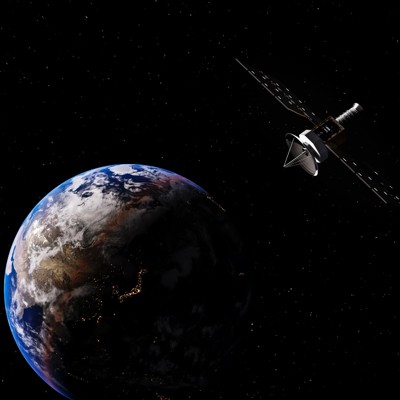
"Can quantum physics enable better, cheaper, faster satellite photos? In a month or two, a startup will test a "quantum camera" for space-based imaging. If it works, it could slash the cost of missile defenses and give smaller NATO allies and partners spy-satellite capabilities that were once exclusive to major powers."
"You might think that the cameras on the world's most expensive satellites are fundamentally different from what your grandfather used to take old movies. But whether using chemicals and paper or chargeable transistors on a circuit, the process of deriving images from the behavior of photons has changed little in more than a century. That is one reason why space-based image collection-especially at high resolution-is incredibly expensive."
Diffraqtion, a Boston startup funded in part by NASA and DARPA, will soon test a "quantum camera" for space-based imaging that collects images using a different photon-based method. Traditional imaging derives pictures from photons hitting dense sensors and remains limited by diffraction, which drives the size and weight of high-resolution satellites. Large lenses and empty space make high-resolution imaging satellites heavy and expensive to launch — roughly $50 million per satellite. Quantum sensing could enable sensors without those dense, heavy components, potentially cutting costs, shrinking satellite size, and expanding high-resolution capabilities to smaller allies.
Read at Nextgov.com
Unable to calculate read time
Collection
[
|
...
]