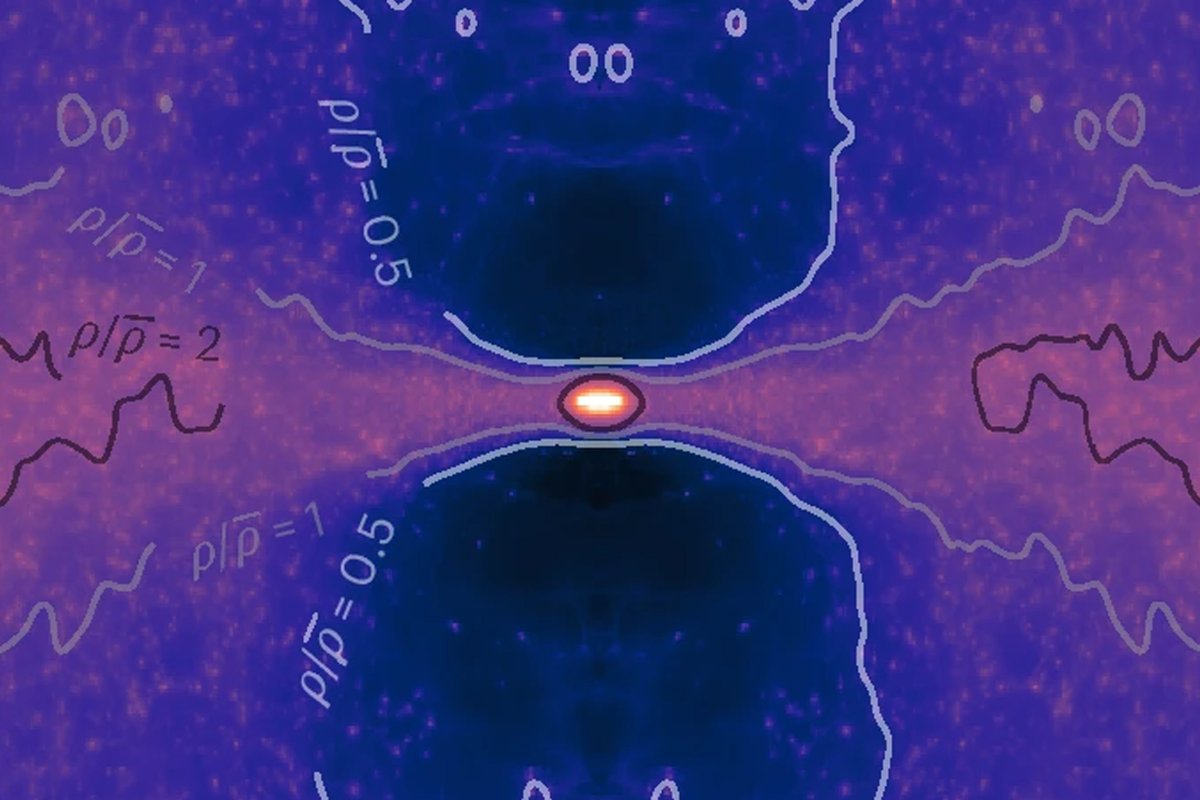
"The Milky Way - and in fact our entire galactic neighborhood known as the Local Group - appear to be lodged in a vast, extended "sheet" of dark matter flanked on each side by cosmic voids, new research suggests. The findings, described in a new study published in Nature Astronomy, could help explain the puzzling motion exhibited by our nearby galaxies, which seems to defy the gravitational influence of neighboring realms."
"The discovery was made after Hubble noticed that nearly every galaxy he observed was moving away from the Earth at a speed directly proportional to its distance. But there was one notable exception: Andromeda, the nearest major galaxy to ours, which was instead moving towards us. This was a head-scratcher, because Andromeda, the Milky Way, and dozens of other nearby galaxies are all gravitationally bound to each other, forming what's known as the Local Group."
The Milky Way and Local Group appear embedded in a vast dark matter sheet millions of light years across, bordered on both sides by cosmic voids. Simulations reconstructed the Local Group's evolution from cosmic microwave background observations to infer initial conditions and a virtual twin that reproduced observed galaxy motions. The simulated galaxy kinematics matched real measurements, indicating that local motions require the Local Group to lie within an extended dark matter sheet. The sheet's mass distribution accounts for anomalous motions such as Andromeda's approach despite cosmic expansion and the expected gravitational behavior of nearby galaxies.
Read at Futurism
Unable to calculate read time
Collection
[
|
...
]