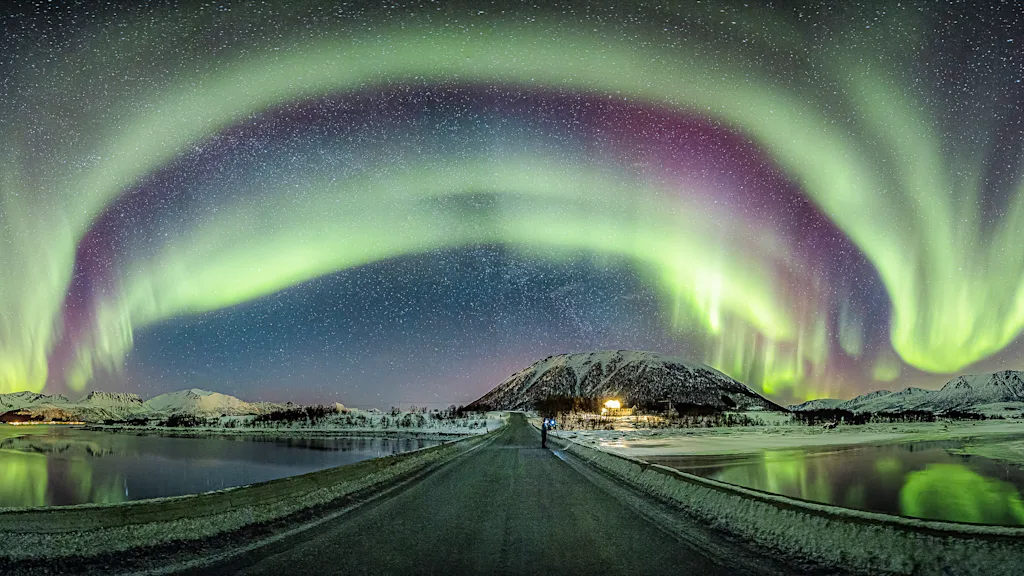
The Northern Lights are expected to appear across nearly 19 U.S. states on March 18-19 due to a G2 moderate geomagnetic storm triggered by a coronal mass ejection from the sun. This solar material reaches Earth and creates green, blue, and purple colors in the night sky. The visibility is enhanced by the upcoming spring equinox, which aligns Earth's magnetic field to better capture solar material. The affected states include Alaska, Idaho, Iowa, Maine, Michigan, Minnesota, Montana, Nebraska, New Hampshire, North Dakota, Oregon, South Dakota, Vermont, Washington, Wisconsin, Wyoming, and northern portions of Indiana, Ohio, and Pennsylvania. Optimal viewing occurs between 10 p.m. and 2 a.m. local time in areas with minimal light pollution, facing north. NOAA provides real-time tracking and 30-minute forecasts on their website.
"The aurora borealis is the result of a geomagnetic storm that occurs when a coronal mass ejection (CME), an eruption of solar material, reaches Earth and causes swaths of green, blue, and purple colors to appear in the dark sky. We are currently seeing increased solar activity as the result of an 11-year sun cycle peak."
"NOAA says this G2, or moderate geomagnetic storm is partially thanks to Friday's upcoming spring equinox, or 'the equinox effect.' The effect doubles the chance of auroras when Earth tilts its axis, thereby causing the planet's magnetic field to better align in a way to uptake solar material."
"For the best viewing, the NOAA recommends facing north, in a spot away from light pollution, between 10 p.m. and 2 a.m. local time. You can track the aurora on the NOAA's website, where the agency is providing updates and visibility in real time, with a 30-minute aurora forecast."
Read at Fast Company
Unable to calculate read time
Collection
[
|
...
]