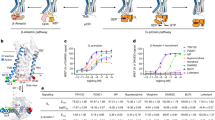
"Hypothesizing that such differences in signaling efficacy may be captured structurally in intermediate states under non-equilibrium conditions, we implemented a time-resolved (TR) cryo-EM approach to visualize the GTP-induced activation of the Gi heterotrimer by the -opioid receptor (MOR) bound to three ligands displaying partial, full, or super-agonism on the receptor1. We resolved ensembles of conformational states along the G-protein activation pathway, including a previously unobserved intermediate state that enabled us to visualize receptor dynamics as a function of bound ligand."
"The results demonstrate ligand-dependent differences in state occupancy and conformational stability, with higher ligand efficacy correlating with increased dynamics of the receptor's transmembrane (TM) helices 5 and 6. Furthermore, we identify key mechanistic differences in the GTP-induced activation of Gi compared to Gs that likely underlie their distinct activation kinetics. Corroborated by molecular dynamics (MD) simulations and single-molecule fluorescence assays,"
Time-resolved cryo-EM captured GTP-induced activation of the Gi heterotrimer by the μ-opioid receptor (MOR) bound to ligands with partial, full, or super-agonism. Ensembles of conformational states along the G-protein activation pathway were resolved, including a previously unobserved intermediate state that revealed ligand-dependent receptor dynamics. Higher ligand efficacy correlated with increased dynamics of transmembrane helices 5 and 6, and ligands altered state occupancy and conformational stability. Mechanistic differences between GTP-induced activation of Gi and Gs were identified that likely explain distinct activation kinetics. Molecular dynamics and single-molecule fluorescence assays corroborated the structural observations.
#gpcr-signaling #-opioid-receptor-mor #time-resolved-cryo-em #gi-activation #conformational-dynamics
Read at www.nature.com
Unable to calculate read time
Collection
[
|
...
]