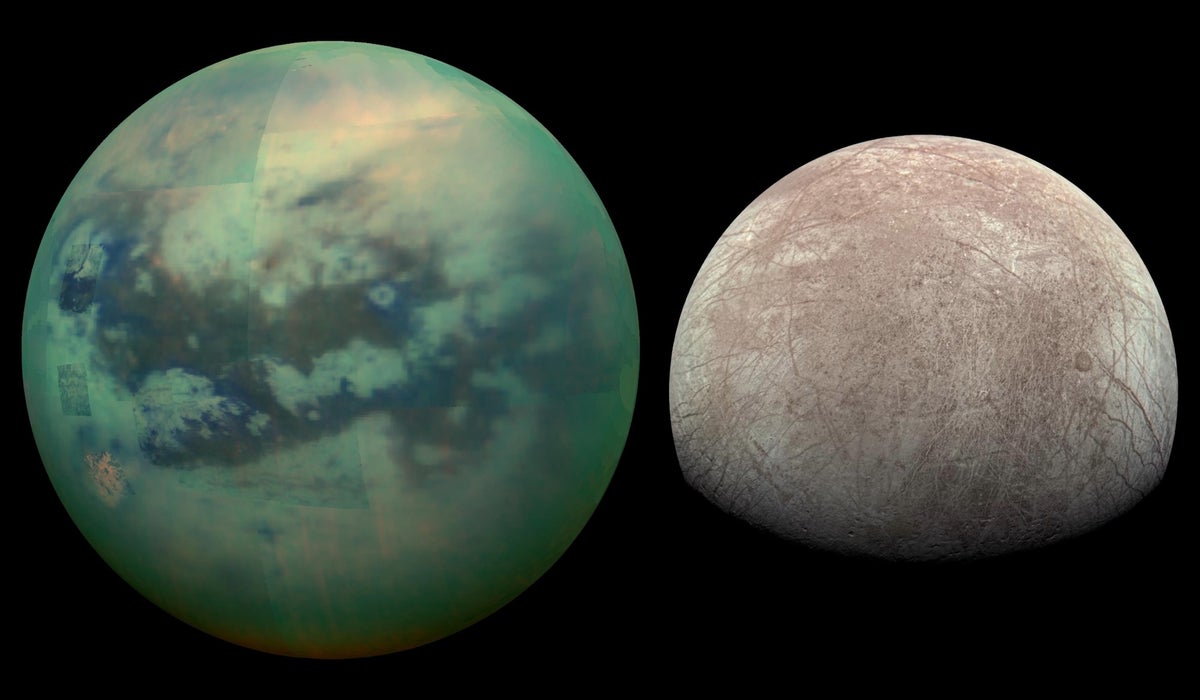
"Among the solar system's hundreds of known moons, few are as enticing as the handful that scientists believe have a global ocean lurking below their crusty surface. But two of these hidden oceans may not be as promising as scientists have hoped, leaving new questions for those interested in the search for life beyond Earth. Those results come from unrelated research papers, both of which were published on December 17."
"Of all the worlds scientists have seen up close to date, it's among the most intriguing. On the surface, Titan is an Earth-like world with a twistliquid hydrocarbons sculpt a landscape of water ice the way terrestrial seas flow over rock crust. That dynamic geology makes it the only moon with any hope of habitable surface conditions. And scientists have also wondered whether Titan hid an ocean layer of water and ammonia below that changeable surface."
Reanalysis of Cassini mission data indicates Titan's hypothesized global ocean is largely an icy slush containing only isolated pockets of liquid water. New observations from Juno indicate Europa's ice shell is relatively thick, which would reduce exchange between the subsurface ocean and the surface. Limited liquid within Titan's interior and a thick Europa ice shell both constrain opportunities for nutrient and chemical transport that could support life. These findings reduce the apparent habitability potential of two major ocean worlds and imply the need for targeted measurements of ice thickness, liquid distribution, and possible pathways for material exchange.
Read at www.scientificamerican.com
Unable to calculate read time
Collection
[
|
...
]