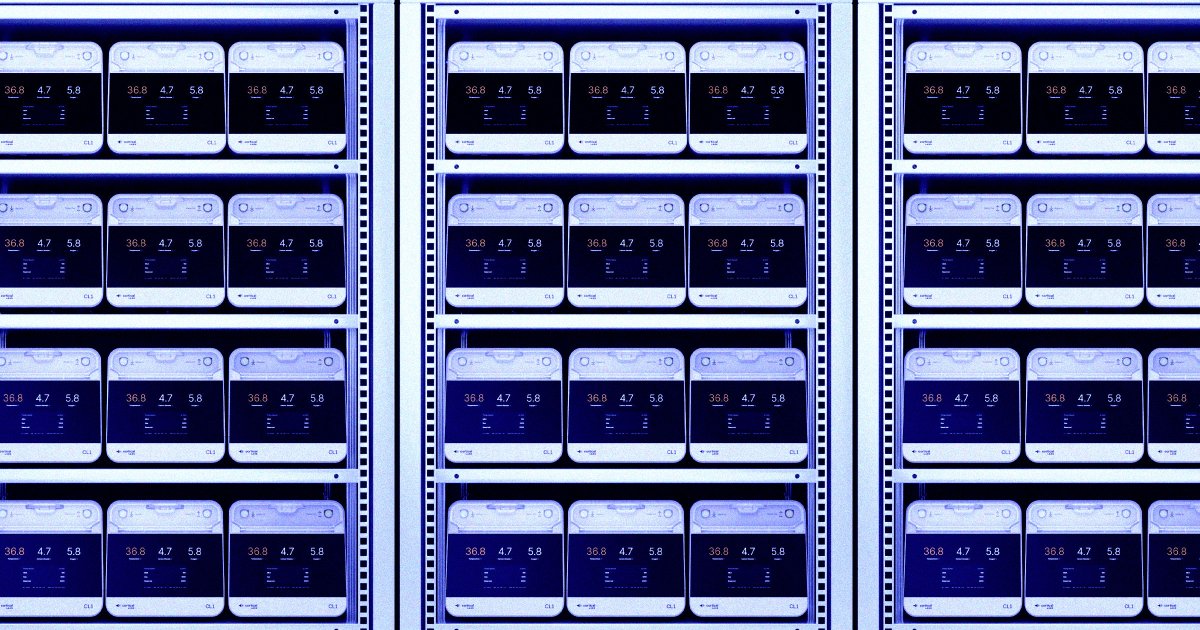
"Cortical Labs is planning to outfit its futuristic facilities with racks of CL1 biological computers, powered by many more human brain cells, instead. The company refers to this approach as "wetware," an unsettling new take on software and hardware terminology. Simply put, the computers send electrical signals to neurons derived from human blood stem cells. The chips embedded within record those neurons' responses as the output."
"Cortical Labs claims that relying on biological computers comes with a massive advantage over their silicon wafer counterparts: future biological data centers will only "consume a fraction of the power used by conventional AI processors," per Bloomberg. CEO Hon Weng Chong told the publication that each CL1 node needs less power than a handheld calculator to run. That's orders of magnitude less power than a modern graphical processing unit requires."
"The company teamed up with DayOne Data Centers, to develop the two facilities. The Melbourne data center will house 120 CL1 units, while DayOne is planning to deploy as many as 1,000 units at the one in Singapore."
Cortical Labs, an Australian biotech startup, has developed CL1 biological computers composed of 200,000 living human neurons. The company demonstrated these neurons learning to play the video game Doom, advancing beyond earlier Pong experiments. Cortical Labs now plans to construct biological data centers in Melbourne and Singapore, housing hundreds to thousands of CL1 units. This "wetware" approach uses electrical signals to communicate with neurons derived from human blood stem cells, with embedded chips recording neural responses. The Melbourne facility will contain 120 units while Singapore will deploy up to 1,000 units. A major claimed advantage is dramatically reduced power consumption compared to conventional AI processors, with each CL1 node requiring less power than a handheld calculator.
#biological-computing #neuromorphic-technology #energy-efficiency #data-centers #artificial-intelligence
Read at Futurism
Unable to calculate read time
Collection
[
|
...
]