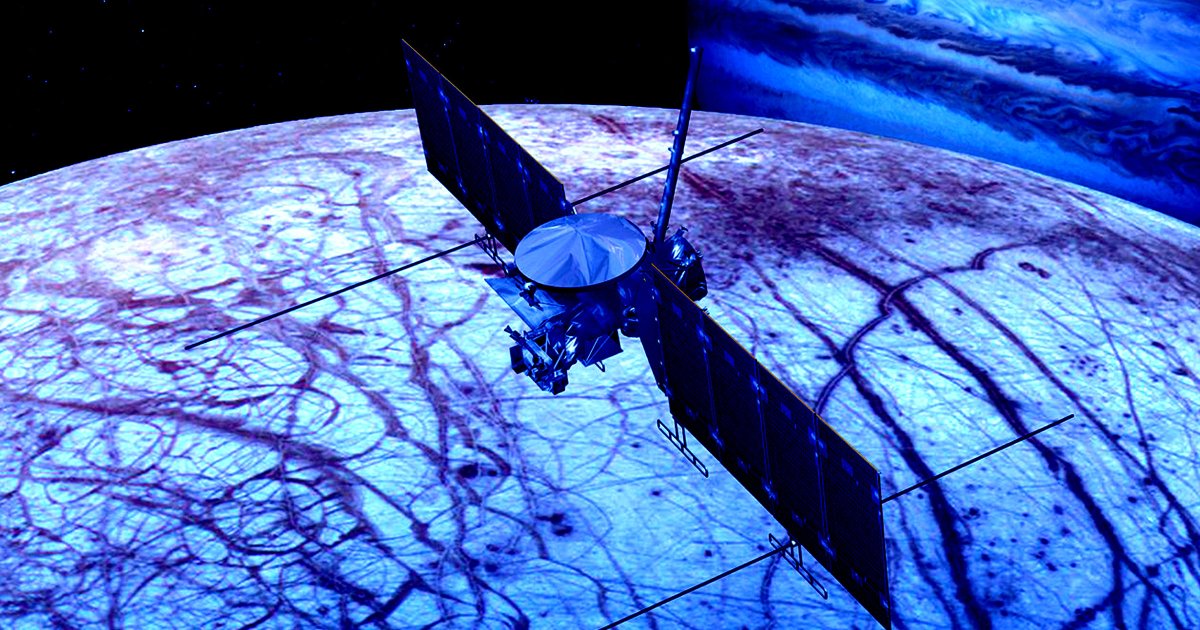
Europa likely hosts a massive salty ocean holding nearly twice the water of Earth's oceans beneath a thick icy shell. Juno mission flyby data from 2022 indicate an average ice shell thickness of about 18 miles in the observed region, refining prior estimates that ranged broadly. A thick shell would extend transport times for nutrients and oxygen to the ocean, affecting habitability. An inner warmer convective layer could increase total thickness, while modest dissolved salt could reduce the solid-ice estimate by roughly three miles. The ice shell may contain cracks, faults, pores or bubbles that could provide exchange pathways; Juno's microwave radiometer detected scatterers to hundreds of metres depth.
"They believe it's covered in a massive salty ocean, holding almost twice as much water as all of Earth's oceans combined, making it one of the best places to look for extraterrestrial life in our solar system - but covered by a formidable icy shell. Now, NASA Jet Propulsion Lab scientists -drawing on data from the agency's Juno mission, which performed a flyby of Europa in 2022 - have determined that this particularly heavenly body is seriously thick,"
"It's the first time we've been able to hone in on a specific measurement. Previous estimates have ranged from half a mile to tens of miles, highlighting how much there's still to learn about Jupiter's icy moon. The estimated thickness of the shell could also have major implications for future efforts to study Europa's habitability. For one, nutrients and other building blocks like oxygen would have a very long way to travel."
Read at Futurism
Unable to calculate read time
Collection
[
|
...
]