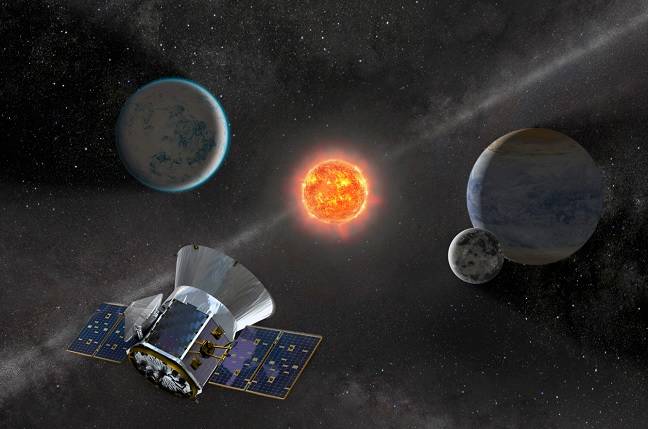
"TESS entered safe mode after being slewed to point at a target. The spacecraft's solar panels did not rotate to remain pointed at the Sun, resulting in a slow discharge of TESS's batteries. A low-power condition was detected, and the spacecraft entered safe mode until ground controllers could address the issue. Things returned to normal at the end of last week, and on January 23, NASA announced that science operations had resumed."
"TESS was launched atop a Falcon 9 on April 18, 2018, on a two-year mission to search for exoplanets. The mission, which detects exoplanets as they pass in front of their parent stars, was extended beyond its original two-year prime mission and is currently planned for operations into the latter half of the decade, with the spacecraft's orbit permitting observations through at least 2028."
TESS entered safe mode on January 15 after a slew left its solar panels misaligned and the batteries slowly discharged. Ground controllers detected the low-power condition and placed the spacecraft into safe mode while they addressed the issue. Operations returned to normal by the end of the week and science observations resumed on January 23. The event occurred during a week of comet 3I/ATLAS observations. TESS launched on April 18, 2018, for an initial two-year exoplanet survey and has been extended, with observations planned through at least 2028. Previous safe-mode episodes and proposed NASA budget cuts have posed additional risks to the mission.
Read at Theregister
Unable to calculate read time
Collection
[
|
...
]