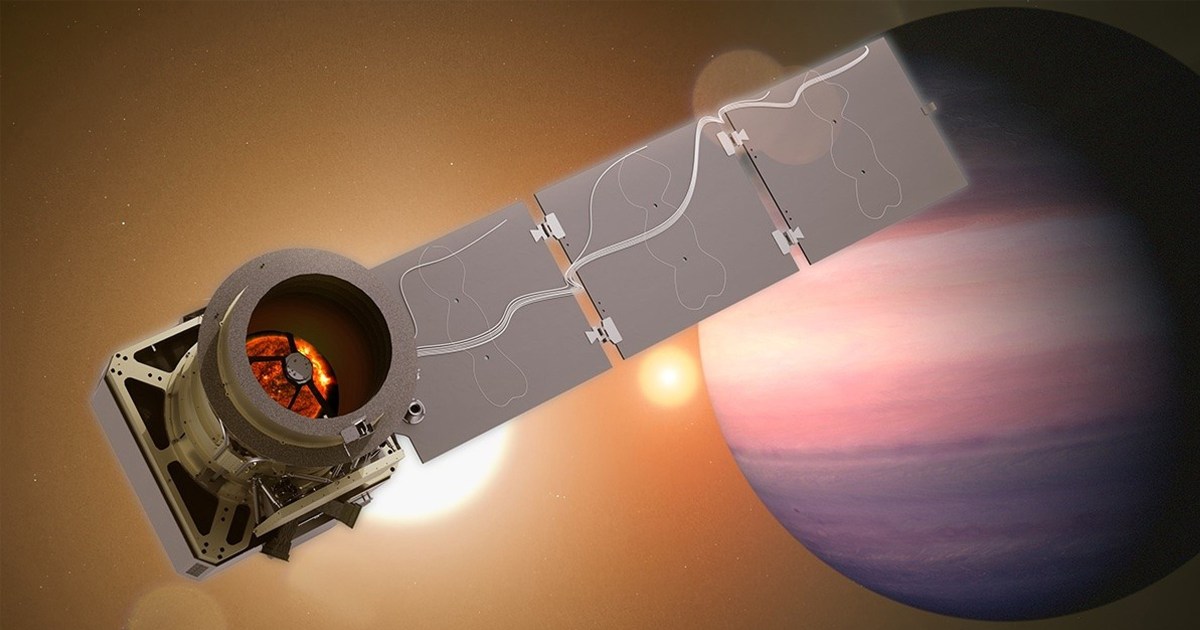
"Dubbed Pandora, the orbital observatory is designed to hunt for distant worlds called exoplanets orbiting other stars. And though not nearly as large or expensive as the James Webb Space Telescope, the 17-inch lens packs a specialized punch that'll help astronomers do something that was unthinkable just a decade or two ago: glean clues from individual exoplanets too remote for even the mighty Webb to pick up on."
"Pandora's mission will last a year, during which it's expected to complete observations of at least 20 exoplanets - as well, in a novel development, of the stars they orbit. This will "shatter a barrier," according to University of Arizona astronomer Daniel Apai, whose team helped build the telescope - helping "remove a source of noise in the data that limits our ability to study small exoplanets in detail and search for life on them," he wrote in a new piece for The Conversation."
A SpaceX Falcon 9 launched NASA's Pandora telescope into Sun-synchronous orbit. Pandora carries a 17-inch lens optimized to observe exoplanets and their host stars. The mission will run one year and aims to complete observations of at least 20 exoplanets while simultaneously monitoring their stars. Pandora's design enables removal of stellar noise that obscures planetary signals, improving the ability to study small exoplanets' atmospheres and search for biosignatures. Exoplanets are faint compared with their host stars; transits produce measurable dips in starlight and allow spectral analysis of atmospheric chemicals. The telescope will probe worlds too dim for larger observatories.
Read at Futurism
Unable to calculate read time
Collection
[
|
...
]