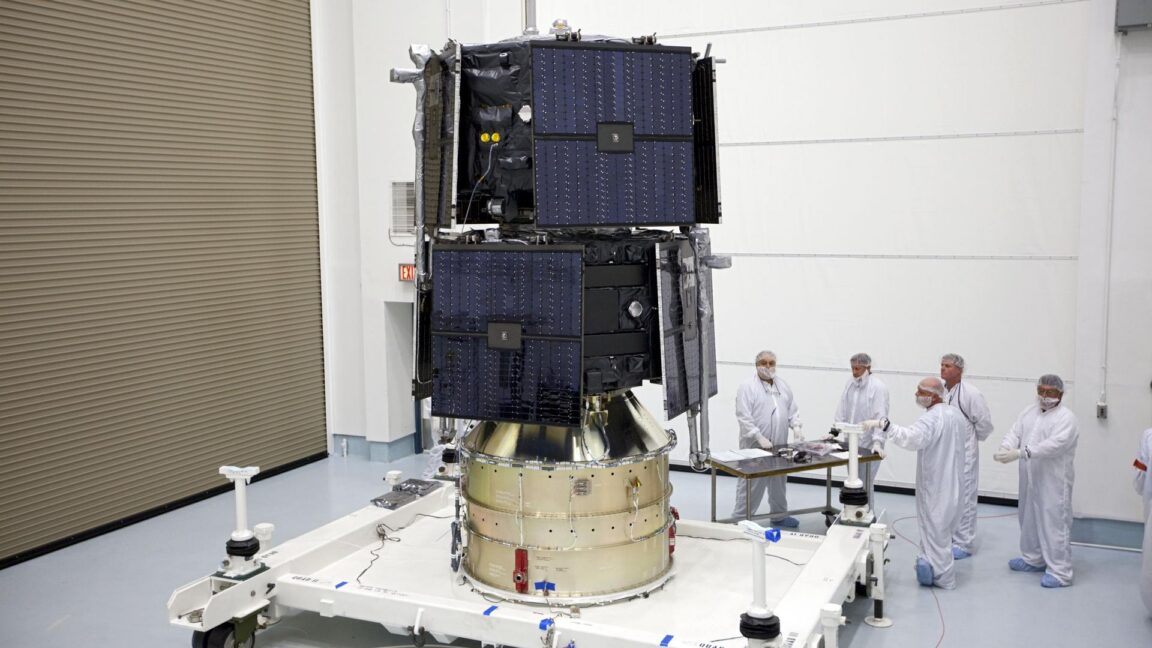
"NASA's two Van Allen Probes launched into elliptical orbits ranging from a few hundred miles above Earth up to an apogee, or high point, of nearly 20,000 miles. The orbits are inclined 10 degrees to the equator, limiting the risk of injury or damage to a swath of the tropics. NASA ended the mission in 2019 when the satellites ran out of fuel."
"Higher-than-anticipated solar activity caused the atmosphere to swell outward, increasing atmospheric drag on the satellites beyond initial estimates, according to NASA. Van Allen Probe B is expected to reenter no earlier than 2030, with a similar risk to the public."
"The two spacecraft were built by the Johns Hopkins University Applied Physics Lab. NASA said the mission made several major discoveries, including 'the first data showing the existence of a transient third radiation belt, which can form during times of intense solar activity.'"
NASA's Van Allen Probes, launched into elliptical orbits with a 10-degree inclination to the equator, were expected to reenter Earth's atmosphere in 2034. However, higher-than-anticipated solar activity caused the atmosphere to expand, increasing atmospheric drag beyond initial estimates. Van Allen Probe B now faces reentry no earlier than 2030. The mission, built by Johns Hopkins University Applied Physics Lab, made significant discoveries including evidence of a transient third radiation belt during intense solar activity. While no one has been injured by falling space debris, property damage has occurred. Several NASA satellites have reentered without meeting government risk standards, though China's uncontrolled reentry of four massive Long March 5B rocket cores represents a greater concern.
#space-debris-reentry #van-allen-probes #solar-activity-atmospheric-drag #orbital-debris-mitigation #spacecraft-reentry-risk
Read at Ars Technica
Unable to calculate read time
Collection
[
|
...
]