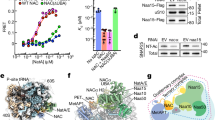
"The nascent polypeptide-associated complex (NAC) is a conserved ribosome-bound factor with essential yet incompletely understood roles in protein biogenesis1. Here, we show that NAC is a multifaceted regulator that coordinates translation elongation, cotranslational folding, and organelle targeting through distinct interactions with nascent polypeptides both inside and outside the ribosome exit tunnel. Using NAC-selective ribosome profiling in C. elegans, we identify thousands of sequence-specific NAC binding events across the nascent proteome, revealing broad cotranslational engagement with hydrophobic and helical motifs in cytosolic, nuclear, ER, and mitochondrial proteins."
"Unexpectedly, we discover an intra-tunnel sensing mode, where NAC engages ribosomes with extremely short nascent polypeptides inside the exit tunnel in a sequence-specific manner. Moreover, initial NAC interactions induce an early elongation slowdown that tunes ribosome flux and prevent ribosome collisions, linking NAC's chaperone activity to kinetic control of tran"
NAC is a conserved ribosome-associated factor that functions as a multifaceted regulator of protein biogenesis. NAC engages thousands of sequence-specific sites across the nascent proteome, preferentially recognizing hydrophobic and helical motifs in proteins destined for the cytosol, nucleus, ER, and mitochondria. NAC contacts nascent polypeptides both outside the ribosome exit tunnel and within the tunnel, revealing an intra-tunnel sensing mode for extremely short nascent chains. Early NAC binding produces an elongation slowdown that adjusts ribosome flux and prevents ribosome collisions. NAC thus couples chaperone engagement to kinetic control of translation and targeting.
Read at www.nature.com
Unable to calculate read time
Collection
[
|
...
]