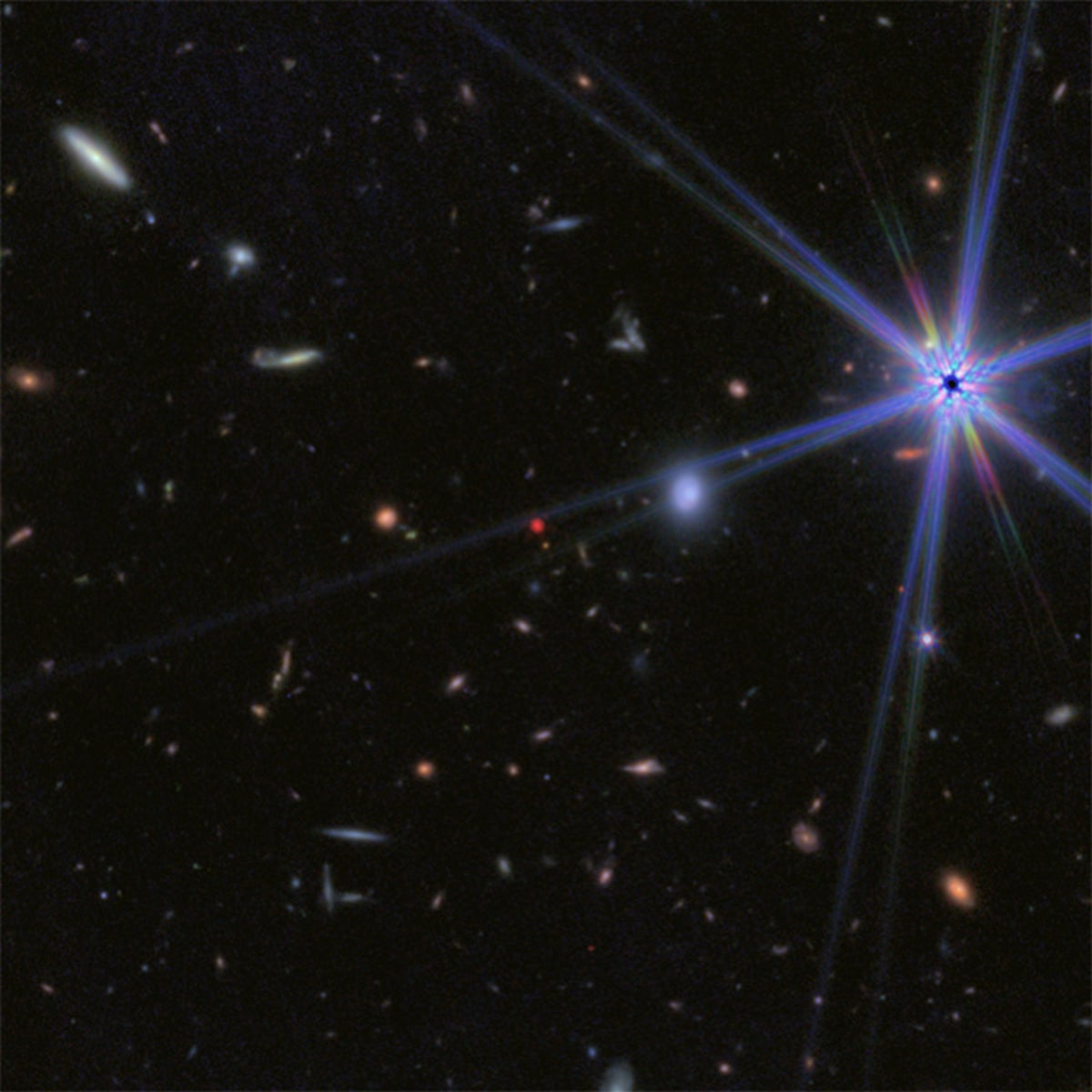
The James Webb Space Telescope found ubiquitous, compact ruby-red specks in images from the universe's first several hundred million years that disappear by about two billion years after the Big Bang. These little red dots (LRDs) appeared too massive and mature to be starburst galaxies yet lacked the x-ray and radio signatures typical of active supermassive black holes. Deeper JWST spectroscopy of a dozen LRDs strengthens the interpretation that they are rapidly accreting, massive black holes cloaked in dense ionized cocoons. Ultraviolet emission from accretion disks can be filtered into visible red light, and the LRDs fade as cocoons are cleared.
"Practically everywhere JWST looked in the sky's distant depths, probing a time when our universe was only several hundred million years old, it saw something hard to explain: bright, curiously compact specks that were ruby red. The spots were ubiquitous in scenes from this early epoch. But then, circa two billion years into the universe's history, they vanished from JWST's view just as inexplicably as they appeared."
"Further investigations of these little red dots (LRDs) deepened the mystery. They looked far too massive and mature to be early galaxies brightened by swarms of newborn stars, yet they weren't blasting out the x-rays and radio waves that are the hallmarks of supermassive black holes feeding on gas and dust. For a time, the LRDs were framed as breaking cosmology because they defied practically every expectation set by well-founded theories."
"If so, the seemingly missing x-ray and radio outbursts from these objects would be cloaked behind dense cocoons of ionized gas. Feeding black holes also usually emit copious ultraviolet radiation from the white-hot disks of material that pile up around their insatiable maws. For the LRDs, that ultraviolet light would filter through their cocoons, trickling out as visible light and creating the characteristic red hue."
Read at www.scientificamerican.com
Unable to calculate read time
Collection
[
|
...
]