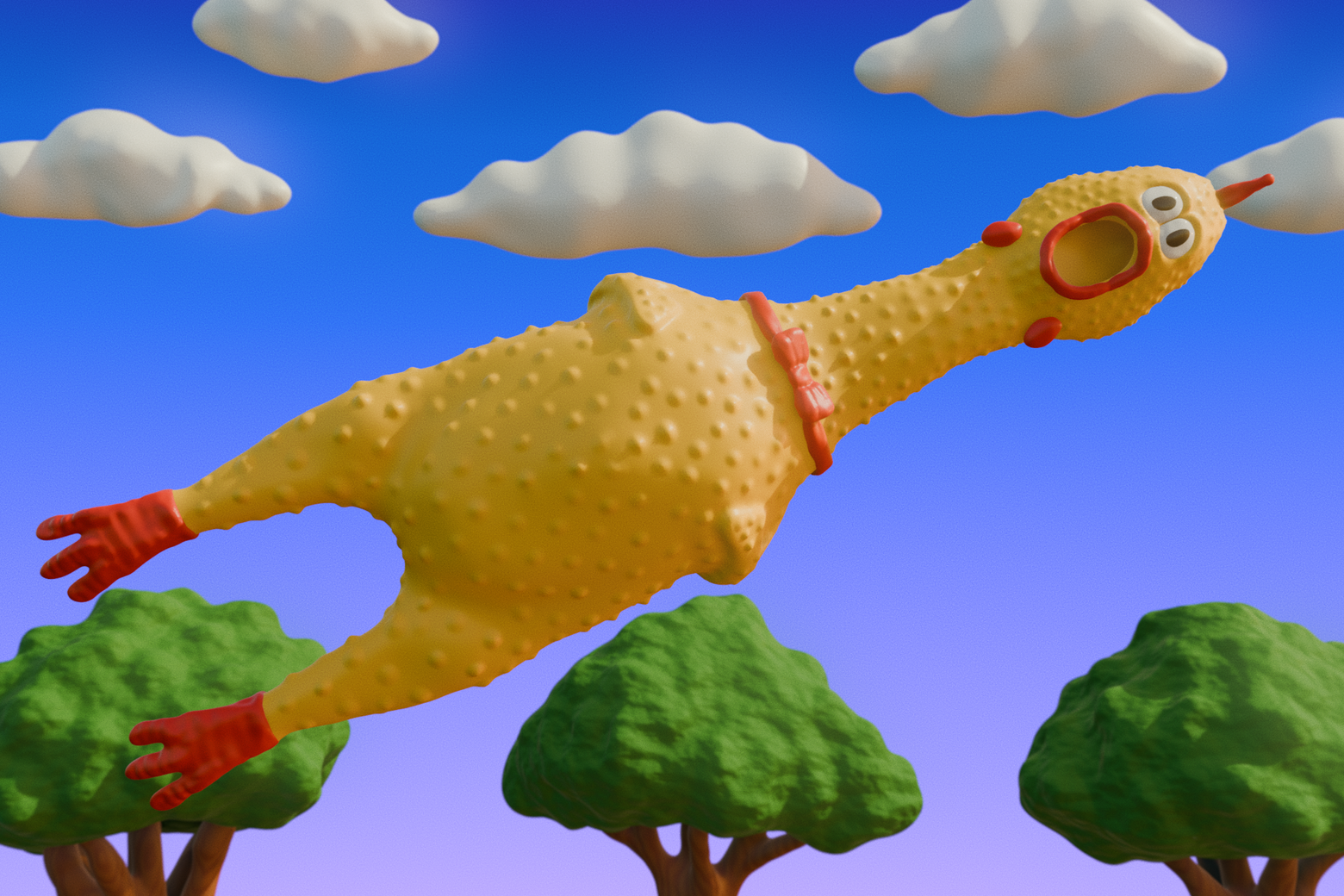
"In fact, it's common for them to travel modest distances via stints of explosive flapping. This phenomenon, known as "burst flight," is sort of beautiful to watch: Chickens leap upward at a sharp angle, then start pumping with manic abandon. As their wings cut tight figure eights, they shoot forward and drop into a glide. They never get very far, but there's something existentially profound in the effort. Chickens fly as if they're trying to escape the inevitable."
"Much of this is true of rubber chickens too. To get airborne, they first need a hefty shot of kinetic force. From there, it's a question of how far this force can take them in defiance of gravity's pull. Things like skin texture (latex is best), length (shorter is better), and weight all influence the trajectory. Depending on the brand and specifications, a rubber chicken might twirl like a football in flight, or strafe on the breeze, or let out a long, braying whine."
Chickens perform brief burst flights, leaping upward at sharp angles, pumping wings in tight figure eights, shooting forward and dropping into a glide. These flights usually cover modest distances and serve mainly for roosting and predator escape. Burst flights are anaerobic exertions comparable to human sprinting, finite and fatiguing. Rubber chickens require a hefty kinetic impulse to become airborne, with skin texture (latex optimal), shorter length, and appropriate weight affecting trajectory. Rubber chickens can twirl, strafe, or emit a braying whine in flight and tend to land gracelessly. One thrown rubber chicken failed to travel far due to wind, size, and suboptimal dimensions, and the thrower's average physical strength limited distance.
Read at Slate Magazine
Unable to calculate read time
Collection
[
|
...
]