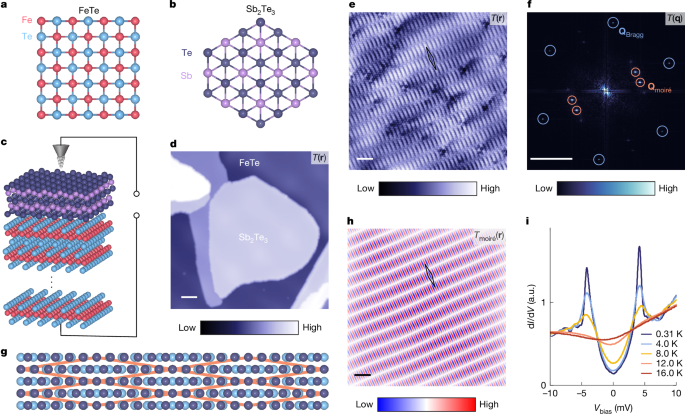
"Cooper-pair density wave (PDW) states emerge spontaneously from strong interactions without breaking time-reversal symmetry. They have attracted considerable interest due to their potential as a phase-incoherent state in the pseudogap regime of cuprates."
"The PDW order breaks lattice translational symmetry and can emerge either as a primary or a subsidiary order of a pre-existing density wave order. A real-space inter-unit-cell modulation of the pairing gap, which is a hallmark of the PDW state, has been observed in a variety of materials."
"Over the past decade, synthetic moiré materials have opened new avenues for engineering tunable periodic potentials. A moiré superlattice potential forms when two atomically thin layers are stacked together with a twist angle or lattice mismatch."
Weak-coupling spin-singlet superconductors under strong Zeeman magnetic fields can exhibit finite-momentum Cooper pairing, resulting in Fulde-Ferrell-Larkin-Ovchinnikov (FFLO) states. Cooper-pair density wave (PDW) states arise from strong interactions without breaking time-reversal symmetry and are significant in the pseudogap regime of cuprates. PDW states can emerge as primary or subsidiary orders and have been observed in various materials. Recent developments in synthetic moiré materials allow for the engineering of tunable periodic potentials, enhancing control over superconducting order parameters.
Read at Nature
Unable to calculate read time
Collection
[
|
...
]