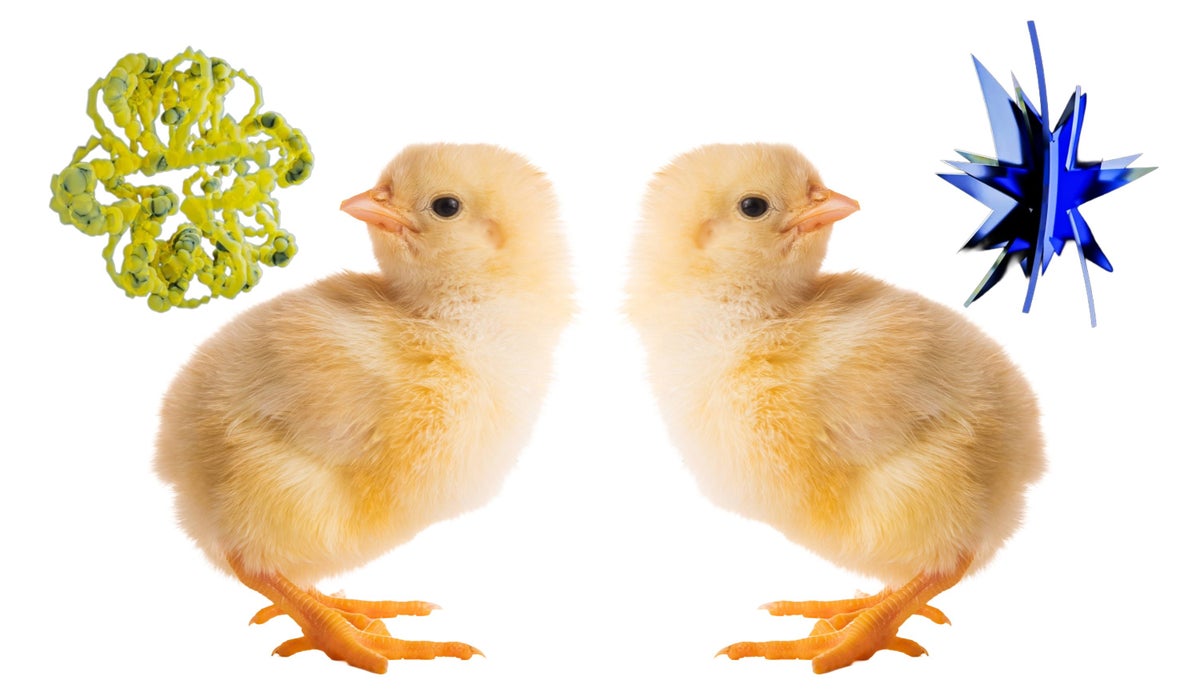
"This intuition that ties certain sounds to shapes is oddly reliable all over the world, and for at least a century, scientists have considered it a clue to the origin of language, theorizing that maybe our ancestors built their first words upon these instinctive associations between sound and meaning. But now a new study adds an unexpected twist: baby chickens make these same sound-shape connections, suggesting that the link to human language may not be so unique."
"The results, published today in Science, challenge a long-standing theory about the so-called bouba-kiki effect: that it might explain how humans first tethered meaning to sound to create language. Perhaps, the thinking goes, people just naturally agree on certain associations between shapes and sounds because of some innate feature of our brain or our world. But if the barnyard hen also agrees with such associations, you might wonder if we've been pecking at the wrong linguistic seed."
"Maria Loconsole, a comparative psychologist at the University of Padua in Italy, and her colleagues decided to investigate the bouba-kiki effect in baby chicks because the birds could be tested almost immediately after hatching, before their brain would be influenced by exposure to the world. The researchers placed chicks in front of two panels: one featured a flowerlike shape with gently rounded curves; the other had a spiky blotch reminiscent of a cartoon explosion."
Baby chicks tested immediately after hatching matched rounded shapes with the sound 'bouba' and spiky shapes with 'kiki'. When played 'bouba', 80 percent of chicks approached the rounded panel first and explored it for more than three minutes on average, compared with under one minute on the spiky panel. The preference reversed when chicks heard 'kiki'. The findings indicate that nonhuman animals can share the same sound-shape associations previously thought tied to human language origins, calling into question the uniqueness of this mapping in humans. Chicks were tested almost immediately after hatching, before visual experience could shape their brains, strengthening the case for an innate or early-developing basis.
Read at www.scientificamerican.com
Unable to calculate read time
Collection
[
|
...
]