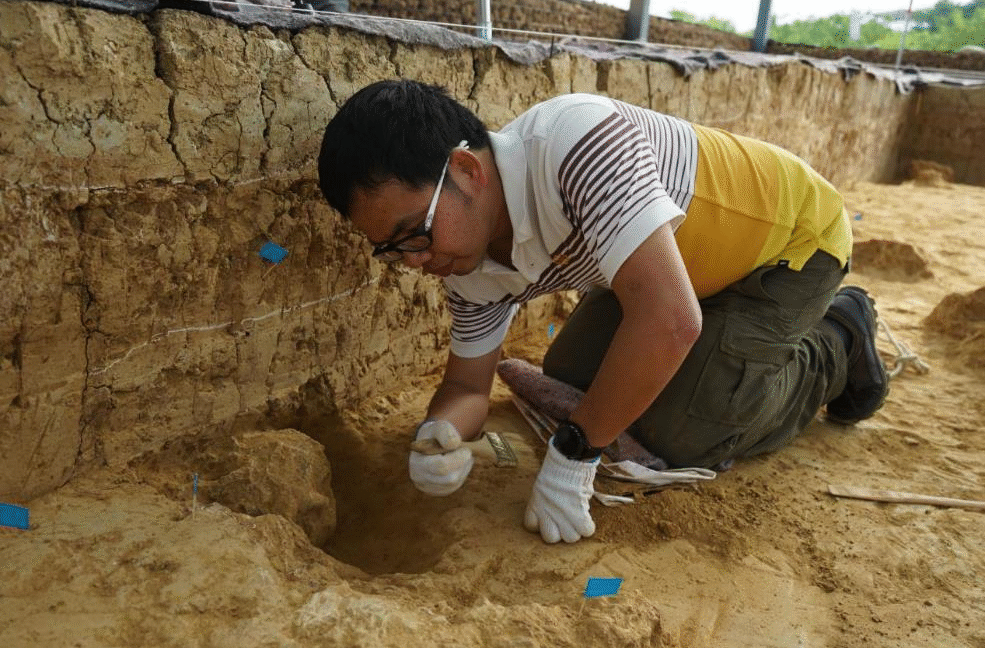
Two skulls from Yunxian are classified as Homo erectus and dated to about 1.77 million years, representing the oldest hominin remains in East Asia. Isotopic ratios of aluminum-26 to beryllium-10 measured in quartz grains from the sediment layer yielded the age estimate. The skulls were recovered with hundreds of stone tools and animal bones from Han River terraces that have been depositing silt and gravel for at least two million years. The age implies Homo erectus dispersed across Asia rapidly, within roughly 130,000 years of the species' appearance in Africa, and suggests Homo erectus might have produced stone tools at older Chinese sites.
"A recent study has re-dated the skulls to about 1.77 million years old, which makes them the oldest hominin remains found so far in East Asia. Their age means that Homo erectus (an extinct common ancestor of our species, Neanderthals, and Denisovans) must have spread across the continent much earlier and much faster than we'd previously given them credit for. It also sheds new light on who was making stone tools at some even older archaeological sites in China."
"Along with hundreds of stone tools and animal bones, the layers of river sediment have yielded three nearly complete hominin skulls (only two of which have been described in a publication so far). Shantou University paleoanthropologist Hua Tu and his colleagues measured the ratio of two isotopes, aluminum-26 and beryllium-10, in grains of quartz from the sediment layer that once held the skulls. The results suggest that Homo erectus lived and died along the Han River 1.77 million years ago."
Read at Ars Technica
Unable to calculate read time
Collection
[
|
...
]