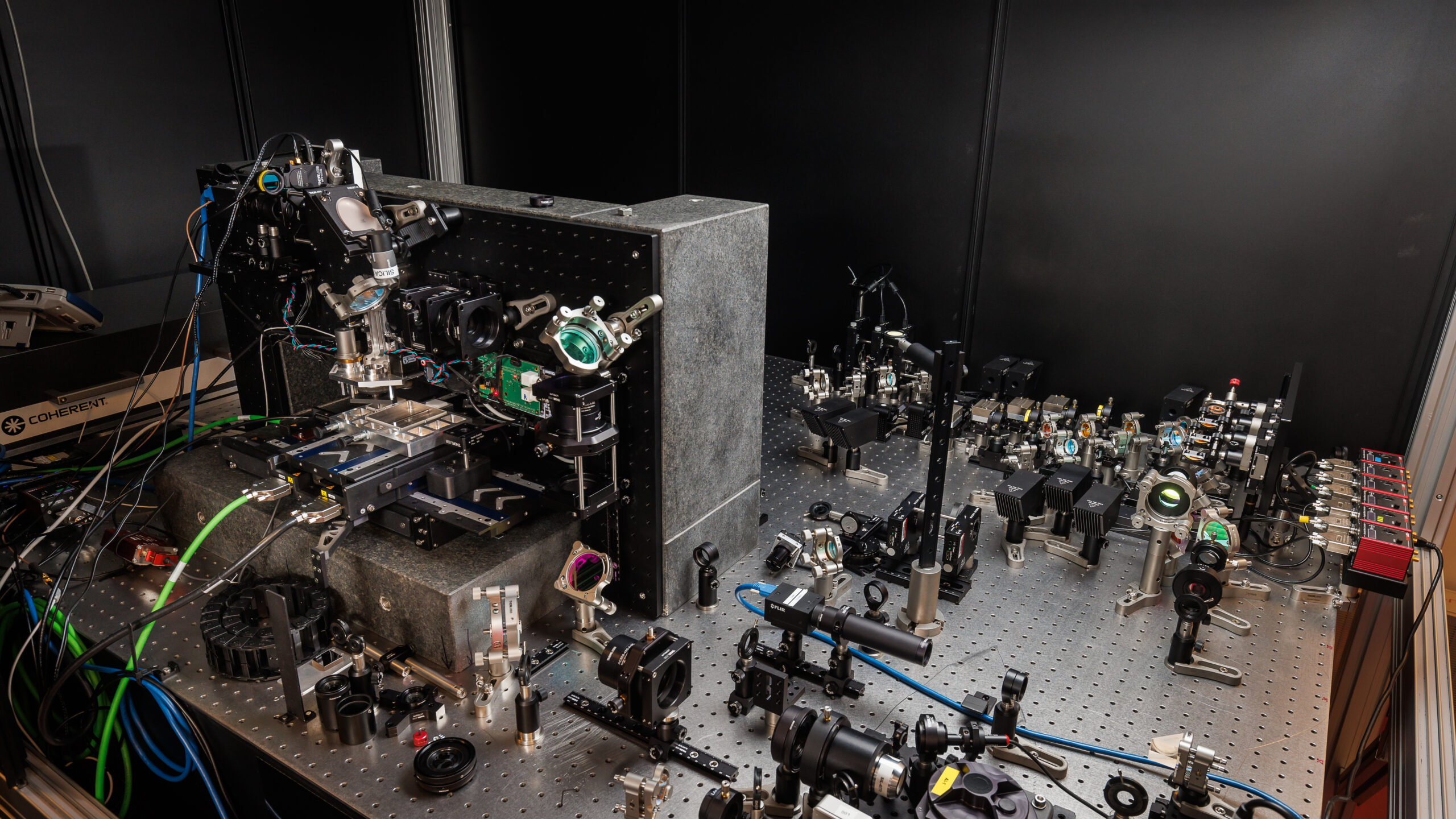
"One type of voxel they tried was based on birefringence, where refraction of photons depends on their polarization. It's possible to etch voxels into glass to create birefringence using polarized laser light, producing features smaller than the diffraction limit. In practice, this involved using one laser pulse to create an oval-shaped void, followed by a second, polarized pulse to induce birefringence."
"The alternative approach involves changing the magnitude of refractive effects by varying the amount of energy in the laser pulse. Again, it's possible to discern more than two states in these voxels, allowing multiple data bits to be stored in each voxel. Reading these in Silica involves using a microscope that can pick up differences in refractive index. (For microscopy geeks, this is a way of saying "they used phase contrast microscopy." )"
Project Silica writes data into fused silica by creating microscopic voxels whose optical properties encode multiple bits. One voxel type uses laser-induced birefringence: a first pulse makes an oval void and a second polarized pulse induces polarization-dependent refraction; voxel identity derives from oval orientation. An alternative voxel type varies refractive-index magnitude by adjusting pulse energy, producing multiple discernible states per voxel. Reading employs phase-contrast microscopy to detect refractive-index differences. Etched layers are spaced so the microscope focuses on one layer at a time. The etching workflow includes symbols to enable automated microscope alignment and decoding.
Read at Ars Technica
Unable to calculate read time
Collection
[
|
...
]