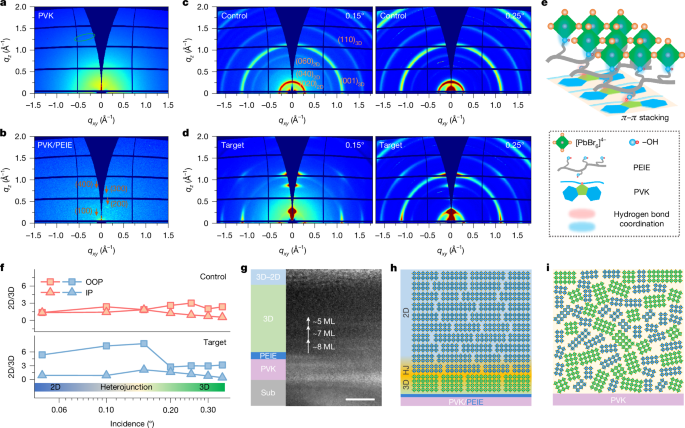
Metal halide perovskites show exceptional luminescent properties and solution processability, but quasi-2D perovskites suffer surface defects and energy disorder that reduce efficiency. A vertical gradient 3D/2D heterojunction is developed using quasi-2D PEA 2(FAPbBr 3)n−1PbBr 4 composition with a PVK/PEIE bilayer HTL. PEIE's −OH groups form hydrogen bonds with PVK and coordinate with Pb2+, templating initial crystallization to produce defect-passivated 3D phases aligned parallel to the substrate and subsequent 2D phase growth on top. The structure confines charges, enhances exciton formation, and improves electroluminescence and device efficiency. The approach avoids complex post-deposition treatments that can damage underlying perovskite integrity and improves reproducibility.
"Metal halide perovskites have emerged as a material for LEDs owing to exceptional luminescent properties and cost-effective solution processability4,5,6,7,8,9,10. Quasi-2D PeLEDs have demonstrated superior device performance and reproducibility because of their quantum well structures9,11,12,13,14,15,16. However, quasi-2D perovskites are usually composed of hybrid and random 3D-2D phases and face two critical challenges: (1) abundant surface defects will lead to severe non-radiative recombination7,17,18,19 and (2) notable energy disorder will interrupt charge transport, hence reducing device efficiency20,21."
"Efficient electroluminescence (EL) of perovskites always depends on the effective charge confinement and high light extraction efficiency (LEE), facilitating exciton formation and device efficiency. Here we developed a vertical gradient 3D/2D perovskite heterojunction using quasi-2D PEA 2(FAPbBr 3)n−1PbBr 4 perovskite composition. A bilayer consisting of poly(9-vinylcarbazole) (PVK)/polyhydric polyethylenimine ethoxylate (PEIE) was used as the hole-transport layer (HTL), in which PEIE plays a dual-interface templating role."
Read at Nature
Unable to calculate read time
Collection
[
|
...
]